I'll be out of the office for the next three weeks. Next week I'm in an offsite training in Crotonville, NY (Leadership, Innovation & Growth course) - the kind 30 Rock made fun of in one of its recent shows. The Crotonville Education Center is GE's famed training facility in a secluded region on the Hudson river (an hour north of New York city) where GE (owns 80% of NBC Universal) routinely gathers its managers from across its $180Bn portfolio of global businesses. Business school professors are invited to update managers on the business frameworks and trends from their latest academic research. Another goal is to provide a forum to managers from diverse businesses to share their best practices and identify synergistic opportunities.
I leave for India over the weekend immediately after the training ends. I'll be in Mumbai/Bombay for the first half of the week of Feb 16, and in Delhi for the rest of the month. In Mumbai I'll be speaking at FRAMES, the biggest conference on the buisness of entertainment in Asia. It's my first time at FRAMES, so I'm looking forward to it. Around 3,000 industry leaders from around the world are expected to attend. It'll be interesting to get a pulse of Asia's media & entertainment market, especially understanding the impact of the ongoing global recession on the industry.
I'm expected to be back in New York on March 1st. I'll blog about my experience upon my return.
February 8, 2009


January 24, 2009
The biggest book deal ever has lessons for content owners in today's digital age
Content owners have struggled to balance copyright laws and new technology as digitally savvy users maintain constant pressure on them to keep up with users' evolving behaviors. Music labels missed the digital revolution and then sued the fans who resorted to illegal downloads of songs. Movie and television studios and book publishers doubled up their ranks of lawyers and lobbyists instead of pro-actively experimenting with new technology to stay ahead of or at least keep up with their users' demand of providing new-technology-enabled, more convenient, content consumption experiences.
Content owners may however be finally learning their lesson - that it is better to redefine legal concepts and create innovative business models in order to help their customers than trying to stop the march of technology.
YouTube, the world's largest online video site, which is still fighting Viacom's $1B+ lawsuit over copyrighted infringement, recently announced a slate of deals with premium content owners. MGM, the financially struggling veteran Hollywood studio, will stream full-length movies and television shows on YouTube (owned by Google). CBS and the independent studio Lionsgate also announced similar content streaming deals with YouTube, which is essentially acknowledging its past mistakes with its stance on copyrights, and is willing to explore how it can together make money with content owners.
Content owners may however be finally learning their lesson - that it is better to redefine legal concepts and create innovative business models in order to help their customers than trying to stop the march of technology.
YouTube, the world's largest online video site, which is still fighting Viacom's $1B+ lawsuit over copyrighted infringement, recently announced a slate of deals with premium content owners. MGM, the financially struggling veteran Hollywood studio, will stream full-length movies and television shows on YouTube (owned by Google). CBS and the independent studio Lionsgate also announced similar content streaming deals with YouTube, which is essentially acknowledging its past mistakes with its stance on copyrights, and is willing to explore how it can together make money with content owners.
But I believe the landmark moment on this issue came in November when Google made a $125M copyright settlement with book publishers and authors, in arguably the biggest book deal ever in the U.S. history.
Under the deal, settled after two years of negotiations, Google will pay $125M to settle claims from authors and publishers for its earlier digital scanning of their copyrighted works without their permission. Google will be able to allow users to buy online access to copyrighted, out-of-print works, and will provide free online views of them at public libraries. Book titles that are still in print will be available only if publishers and authors agree to include them in the Google Book Search program, that is aimed at copying and indexing books, including copyrighted works, and allowing users to search through them online.
The settlement will provide a potentially lucrative e-commerce revenue stream to Google, that derived 99% of its total 2008 revenue ($21.8Bn) from advertising. A framework has been laid out for a new system that will track total revenue generated by Google from books (book sales, advertising and other fees) and split it between Google (37%) and authors & publishers (63%).
Google' s corporate mission is to "organize the world's information and make it universally accessible and useful." And make money through contextual advertising alongside that information. Google's Book Search program is another initiative by the company towards this mission.
Legal experts would read between the lines of the Google settlement to re-interpret the “fair use” doctrine of copyright law. Google, on the other hand, still maintains that the "fair use" clause allows it to continue its practice of indexing all Web content by its search engine and generating revenue without sharing it with content owners. “It is not a concession of our legal position,” said David Drummond, Google’s chief legal officer.
As the digital media industry matures, we'll see more interpretations and redefinitions of legal concepts such as fair use, many of which were defined in the age before Internet, as a medium to consume content, changed everything. There will also be revisions of business practices regarding who gets paid what and by whom.
I hope one of the most important lessons from the Google settlement is a reminder to owners of intellectual property that they can choose to lock it away, give it away, or, most sensibly, share it in exchange for reasonable compensation.
For now, I won't be surprised to see Viacom lawyers back in the news on the company's $1Bn lawsuit against Google.
January 20, 2009
Barack Obama's Inauguration day
Today President-elect Barack Obama will take oath to the Office and become the 44th President of the Unites States of America. It is a special day, not just for Americans but for people all around the world.
I read this quote somewhere: "Rosa Parks sat down (on the bus seat) so that Dr. Martin Luther King can walk. Dr. King walked so that Barack Obama can run. Obama ran so that America can fly."
Obama takes Office with unprecedented weight of expectations from people hoping for tremendous change. As mentioned above, this hope is not limited to within America. Since Obama's presidential election victory on November 4th, my wife and I have traveled to Italy and Brazil over the past two months. Every where we went, people inquired about Barack Obama and his victory the moment they discovered we were Americans. The sheer joy and hope they openly conveyed about Obama becoming the next U.S. President were truly remarkable.
I just hope American people will show patience to see the results - it seems some are expecting miracles to start happening within 100 hours after Obama takes Office, leave aside 100 days.
Given today is a working day, we may see big numbers for online streaming from people at work who want to participate in the Inauguration ceremony in Washington D.C. where up to two million people are expected to congregate from all over the world. Here are several online options for you, as aggregated by GigaOm.
I'll be taking time out between meetings to watch the coverage. You may also want to catch some of the moments of this truly historic day.
I read this quote somewhere: "Rosa Parks sat down (on the bus seat) so that Dr. Martin Luther King can walk. Dr. King walked so that Barack Obama can run. Obama ran so that America can fly."
Obama takes Office with unprecedented weight of expectations from people hoping for tremendous change. As mentioned above, this hope is not limited to within America. Since Obama's presidential election victory on November 4th, my wife and I have traveled to Italy and Brazil over the past two months. Every where we went, people inquired about Barack Obama and his victory the moment they discovered we were Americans. The sheer joy and hope they openly conveyed about Obama becoming the next U.S. President were truly remarkable.
I just hope American people will show patience to see the results - it seems some are expecting miracles to start happening within 100 hours after Obama takes Office, leave aside 100 days.
Given today is a working day, we may see big numbers for online streaming from people at work who want to participate in the Inauguration ceremony in Washington D.C. where up to two million people are expected to congregate from all over the world. Here are several online options for you, as aggregated by GigaOm.
I'll be taking time out between meetings to watch the coverage. You may also want to catch some of the moments of this truly historic day.
December 29, 2008
The Middle East crisis
We're currently in Rio De Janeiro for the Christmas break. As a tumultuous year comes to a close - that witnessed a historic election in the U.S.A., Beijing 2008 Olympics spectacle, the worst global financial crisis since the Great Depression, and the deadly terrorist attacks in Mumbai - the global community would have preferred the year to end on some positive note instead of the developing crisis in the Middle East. What we've been watching on the BBC at our hotel over the last three days is shocking, to say the least. Israel on Saturday launched its deadliest attacks ever in Gaza against Hamas targets. The three days of heavy air attacks by Israeli warplanes have claimed over 300 lives, including dozens of innocent women and children.
A serious humanitarian crisis is emerging due to lack of medicine, doctors, food, and other necessary basic supplies that cannot reach the Palestinian refugees in Gaza caused by Israeli air strikes and blocked borders.
Photo Source: Alyson Hurt/NPR
 Gaza Strip is one of the most densely populated areas in the world, with over 1.5M Palestinians living in this narrow strip of land bordering the Mediterranean Sea. It's therefore bound to result in heavy collateral damage in the face of such an indiscriminate, all-out Israeli air attacks. Israel claims it was provoked by Hamas rocket attacks into its territory, which came at the end of the six-month long ceasefire between the two parties. I however feel that the Israeli response to the Hamas rocket attacks, even if it's true, is extremely disproportionate.
Israel is defeating its own cause and inciting further terrorism by causing severe civilian casualties, that certain reporters are calling as "massacre." Hamas may be a terrorist organization for Israel, but they are freedom fighters against Israeli occupation for Palestinians. Keep in mind that Hamas won landslide victory in democratic elections in Gaza couple of years back. Similar Israeli military actions earlier against Hezbollah north of its borders emboldened that organization and made it stronger and more popular in Syria & Lebanon. Israel should learn from its past mistakes and modify its strategy. Same actions will bring in same results, and keep dragging this long conflict painfully further.
Israel has a right to protect its citizens by all means, but it is expected to act more responsibly and not buckle under populism demand of certain sections of its population. Such indiscriminate attack by one of the world's most sophisticated military powers against a defenseless group is only going to create more hatred and anger against Israel in Middle East and across the world. It'll also create cynicism towards Israel's claimed preference for a peaceful settlement to the Palestinian issue, which as we all know will only get resolved through diplomacy, rather than militarily.
Already there has been a strong outpouring of support for affected Palestinians by world leaders, who are demanding an immediate cease-fire by Israel.
There are strong parallels to the situation in Israel with that in Kashmir, where decades of armed conflict between India and Pakistan to control this border region has only resulted in loss of thousands of lives and misery for innocent civilians without any solution.
I made my first trip to Israel last year to meet digital media startups. It's amazing that a small country like Israel can be a hub for technology innovation on such a scale. I met over a dozen startups and maybe half a dozen VC firms in four days. I took some time off to also tour through the area, as I definitely needed an education to the region's absolutely fascinating history.
I took a guided tour of the walled city of Old Jerusalem (Old City), that is housed within the current Jerusalem. My guide was a Canadian Jew who had migrated and settled in Jerusalem. He was terrific. He gave me a lesson in history ranging back to the age of Abraham and the birth of Christianity, Judaism and Islam - the three main religions of the world - from this small city less than half a square mile large.
But I wanted the Palestinian view as well, in order to get a balanced perspective. I was lucky to find a Palestinian employee at the hotel concierge, who drove a taxi in his spare time. He agreed to be my guide for the whole of next day, and drive me back to Tel Aviv, from where I had to fly back to New York.
He told me that it's much more lucrative to be a guide for the historic Old City, but complained that it's virtually impossible for him to get that job - almost all those guides are Jews. Israel apparently wants to control the version of the history told to foreign tourists about the disputed land that is claimed by members of all the three religions.
I enjoyed the driving tour by my Palestinian guide almost as much, if not more, than the walking tour of the religiously-rich Old City. I drove through the north and east region immediately outside the Old City; saw the so called "Berlin Wall" around Jerusalem that is being built by Israel to control Palestinian movement into Jerusalem; visited Israeli settlements around Jerusalem and the West Bank; went up to Masada and heard its incredible story; saw the caves of the Dead Sea Scrolls; and took a dip in the salty waters of the Dead Sea.
It's extremely unfortunate that a region with such an amazing history has been mired in a protracted conflict that has lost so many lives. I hope better sense will prevail, and concerted efforts are made towards a speedy and peaceful resolution of the conflict between Israel and Palestine, the sentiments of which affect the entire region of Middle East.
I strongly feel that no solution to this conflict can be reached without an active mediation from the United States. The current Bush administration in this regard failed miserably during its eight years in office - they have no progress to show for. The ongoing conflict in Gaza will necessitate President-elect Obama to add Israel/Palestine peace process to his growing list of "urgent issue to address" once he takes the oath of Office on January 20th, if it was not already on his agenda.
I want to leave the readers with this picture that I took during my recent visit to Israel of the graffiti on the "Berlin Wall" that Israel has built around Jerusalem. It captures the sentiments of affected civilians and the unfortunate story of the region.
 Photo Source: Sab Kanaujia
A serious humanitarian crisis is emerging due to lack of medicine, doctors, food, and other necessary basic supplies that cannot reach the Palestinian refugees in Gaza caused by Israeli air strikes and blocked borders.
Photo Source: Alyson Hurt/NPR
 Gaza Strip is one of the most densely populated areas in the world, with over 1.5M Palestinians living in this narrow strip of land bordering the Mediterranean Sea. It's therefore bound to result in heavy collateral damage in the face of such an indiscriminate, all-out Israeli air attacks. Israel claims it was provoked by Hamas rocket attacks into its territory, which came at the end of the six-month long ceasefire between the two parties. I however feel that the Israeli response to the Hamas rocket attacks, even if it's true, is extremely disproportionate.
Israel is defeating its own cause and inciting further terrorism by causing severe civilian casualties, that certain reporters are calling as "massacre." Hamas may be a terrorist organization for Israel, but they are freedom fighters against Israeli occupation for Palestinians. Keep in mind that Hamas won landslide victory in democratic elections in Gaza couple of years back. Similar Israeli military actions earlier against Hezbollah north of its borders emboldened that organization and made it stronger and more popular in Syria & Lebanon. Israel should learn from its past mistakes and modify its strategy. Same actions will bring in same results, and keep dragging this long conflict painfully further.
Israel has a right to protect its citizens by all means, but it is expected to act more responsibly and not buckle under populism demand of certain sections of its population. Such indiscriminate attack by one of the world's most sophisticated military powers against a defenseless group is only going to create more hatred and anger against Israel in Middle East and across the world. It'll also create cynicism towards Israel's claimed preference for a peaceful settlement to the Palestinian issue, which as we all know will only get resolved through diplomacy, rather than militarily.
Already there has been a strong outpouring of support for affected Palestinians by world leaders, who are demanding an immediate cease-fire by Israel.
There are strong parallels to the situation in Israel with that in Kashmir, where decades of armed conflict between India and Pakistan to control this border region has only resulted in loss of thousands of lives and misery for innocent civilians without any solution.
I made my first trip to Israel last year to meet digital media startups. It's amazing that a small country like Israel can be a hub for technology innovation on such a scale. I met over a dozen startups and maybe half a dozen VC firms in four days. I took some time off to also tour through the area, as I definitely needed an education to the region's absolutely fascinating history.
I took a guided tour of the walled city of Old Jerusalem (Old City), that is housed within the current Jerusalem. My guide was a Canadian Jew who had migrated and settled in Jerusalem. He was terrific. He gave me a lesson in history ranging back to the age of Abraham and the birth of Christianity, Judaism and Islam - the three main religions of the world - from this small city less than half a square mile large.
But I wanted the Palestinian view as well, in order to get a balanced perspective. I was lucky to find a Palestinian employee at the hotel concierge, who drove a taxi in his spare time. He agreed to be my guide for the whole of next day, and drive me back to Tel Aviv, from where I had to fly back to New York.
He told me that it's much more lucrative to be a guide for the historic Old City, but complained that it's virtually impossible for him to get that job - almost all those guides are Jews. Israel apparently wants to control the version of the history told to foreign tourists about the disputed land that is claimed by members of all the three religions.
I enjoyed the driving tour by my Palestinian guide almost as much, if not more, than the walking tour of the religiously-rich Old City. I drove through the north and east region immediately outside the Old City; saw the so called "Berlin Wall" around Jerusalem that is being built by Israel to control Palestinian movement into Jerusalem; visited Israeli settlements around Jerusalem and the West Bank; went up to Masada and heard its incredible story; saw the caves of the Dead Sea Scrolls; and took a dip in the salty waters of the Dead Sea.
It's extremely unfortunate that a region with such an amazing history has been mired in a protracted conflict that has lost so many lives. I hope better sense will prevail, and concerted efforts are made towards a speedy and peaceful resolution of the conflict between Israel and Palestine, the sentiments of which affect the entire region of Middle East.
I strongly feel that no solution to this conflict can be reached without an active mediation from the United States. The current Bush administration in this regard failed miserably during its eight years in office - they have no progress to show for. The ongoing conflict in Gaza will necessitate President-elect Obama to add Israel/Palestine peace process to his growing list of "urgent issue to address" once he takes the oath of Office on January 20th, if it was not already on his agenda.
I want to leave the readers with this picture that I took during my recent visit to Israel of the graffiti on the "Berlin Wall" that Israel has built around Jerusalem. It captures the sentiments of affected civilians and the unfortunate story of the region.
 Photo Source: Sab Kanaujia
December 1, 2008
Quote of the day
"Washington will bail out those who shower before work, but not those who shower afterwards" - Leo Gerard, President, Steelworkers Union.
Gerard was commenting on U.S. Congress' seemingly double standard in providing massive Federal help to rich banks and its white collar employees while erecting stricter hurdles in order to help the Detroit auto industry that supports millions of blue collar workers.
Congress last week drove Detroit's Big Three CEOs out of Washington, D.C., ordering them not to return with their tin cups until they could guarantee that their auto companies will be viable if provided a $25 billion Federal bailout. In contrast, Citigroup was approved a $20 billion government loan just days later, within 48 hours of making that request to Federal officials. In October, the bank had already received its first $25 billion from the government, which this time also backed $306 billion worth of Citigroup's risky loans and securities.
Washington, D.C. is a white collar town. Several prominent figures in the banking industry - Citigroup's Robert Rubin, a former Secretary of the Treasury, and UBS's Phil Gramm, a former Texas Senator - previously worked in Washington and have the potential to influence its policies. It's not surprising that Congress is therefore seen more sympathetic to the cause of the banking industry compared to that of the auto industry in Detroit, a blue collar town, by contrast.
Gerard was commenting on U.S. Congress' seemingly double standard in providing massive Federal help to rich banks and its white collar employees while erecting stricter hurdles in order to help the Detroit auto industry that supports millions of blue collar workers.
Congress last week drove Detroit's Big Three CEOs out of Washington, D.C., ordering them not to return with their tin cups until they could guarantee that their auto companies will be viable if provided a $25 billion Federal bailout. In contrast, Citigroup was approved a $20 billion government loan just days later, within 48 hours of making that request to Federal officials. In October, the bank had already received its first $25 billion from the government, which this time also backed $306 billion worth of Citigroup's risky loans and securities.
Washington, D.C. is a white collar town. Several prominent figures in the banking industry - Citigroup's Robert Rubin, a former Secretary of the Treasury, and UBS's Phil Gramm, a former Texas Senator - previously worked in Washington and have the potential to influence its policies. It's not surprising that Congress is therefore seen more sympathetic to the cause of the banking industry compared to that of the auto industry in Detroit, a blue collar town, by contrast.
November 27, 2008
Terrorist attacks in Mumbai
While we celebrate Thanksgiving during this long holiday weekend in the U.S., half way across the globe, the largest democracy in the world faces its toughest challenge yet in its war against terrorism. What has been unfolding over the past 36 hours in Mumbai (formerly, Bombay), India's largest metropolitan city with a population of 19M and the hub of its commercial and entertainment industries, is outrageously shocking. Terrorists had literally taken seize of South Mumbai, the city's richest and most popular area, and went on the rampage with indiscriminate shootings and bombings with a focus on city's several symbolic targets. The last count of casualties showed 134 dead and 308 injured, including 12 foreigners and Mumbai's Anti-Terrorism police chief. At this hour, some terrorists are still holding out their positions with sufficient armaments inside the Taj Mahal Palace hotel, arguably the city's most popular spot amongst rich, celebrities and foreign tourists.
I extend my solemn condolences for all who lost their loved ones. My wife is from South Mumbai, but fortunately everyone from her family is safe. Her relatives live in and around Colaba, which was the ground zero for the deadly attacks. But some of my wife's friends and relatives have been directly affected.
The map below shows a timeline of the synchronized terrorist attacks and affected areas of Mumbai. Click on the map to enlarge it.
 Source: NDTV.com
While Mumbai has been repeatedly hit by terrorism in recent years, the difference in the attacks this time is the scale of coordination across simultaneous multiple locations, targeting of foreigners, and the choice of the picked iconic landmarks in the city. Another major difference, a disturbing one, is the possible emergence of internal Islamic terrorist groups aligned with al-Qaeda and its agenda from within India, the home to 140M Muslims, third largest in the world. A little known Indian group by the name of Deccan Mujahideen has claimed responsibility for the Mumbai attacks, but we cannot be assured whether these claims are true and/or other external terrorist groups are not involved. India has a history of being targeted by Islamic fundamentalist terrorist groups based in Pakistan, Afghanistan and Middle East.
I hope the Indian government takes tough, concrete actions this time. It has been rather soft after previous terrorist attacks on its soil, when despite having definitive proof of the involvement of specific groups based in Pakistan and Pakistan-occupied Kashmir (PoK), the Indian government, sometimes under pressure from the U.S., restrained from retaliatory actions due to the fear of escalating wider tensions with Pakistan. But the time has come when Pakistan has to match its rhetoric against terrorism with actions on the ground. It got to fully cooperate with India in investigating the Mumbai attacks, and aggressively go after every terrorist group in Pakistan that may be involved in these deadly attacks.
In parallel, India will need to work extremely hard in restoring the confidence, especially overseas, in its ability to keep its cities and people safe and secure. The psychological damage to the country's reputation cannot be overstated. With the Indian economy already slowing down amidst the ongoing global recession, the timing of these terrorist attacks on India's commercial capital could not have been worse.
I extend my solemn condolences for all who lost their loved ones. My wife is from South Mumbai, but fortunately everyone from her family is safe. Her relatives live in and around Colaba, which was the ground zero for the deadly attacks. But some of my wife's friends and relatives have been directly affected.
The map below shows a timeline of the synchronized terrorist attacks and affected areas of Mumbai. Click on the map to enlarge it.
 Source: NDTV.com
While Mumbai has been repeatedly hit by terrorism in recent years, the difference in the attacks this time is the scale of coordination across simultaneous multiple locations, targeting of foreigners, and the choice of the picked iconic landmarks in the city. Another major difference, a disturbing one, is the possible emergence of internal Islamic terrorist groups aligned with al-Qaeda and its agenda from within India, the home to 140M Muslims, third largest in the world. A little known Indian group by the name of Deccan Mujahideen has claimed responsibility for the Mumbai attacks, but we cannot be assured whether these claims are true and/or other external terrorist groups are not involved. India has a history of being targeted by Islamic fundamentalist terrorist groups based in Pakistan, Afghanistan and Middle East.
I hope the Indian government takes tough, concrete actions this time. It has been rather soft after previous terrorist attacks on its soil, when despite having definitive proof of the involvement of specific groups based in Pakistan and Pakistan-occupied Kashmir (PoK), the Indian government, sometimes under pressure from the U.S., restrained from retaliatory actions due to the fear of escalating wider tensions with Pakistan. But the time has come when Pakistan has to match its rhetoric against terrorism with actions on the ground. It got to fully cooperate with India in investigating the Mumbai attacks, and aggressively go after every terrorist group in Pakistan that may be involved in these deadly attacks.
In parallel, India will need to work extremely hard in restoring the confidence, especially overseas, in its ability to keep its cities and people safe and secure. The psychological damage to the country's reputation cannot be overstated. With the Indian economy already slowing down amidst the ongoing global recession, the timing of these terrorist attacks on India's commercial capital could not have been worse.
November 21, 2008
Death of Investment Banking - The New Wall Street
September 21, 2008 will be etched on the tombstone of the investment banking industry. The day marked the death of investment banks in America. On that day, the last two remaining independent U.S. investment banks, Goldman Sachs and Morgan Stanley, converted themselves into commercial banks, which take consumer deposits, a more conservative source of money. With the move, Wall Street as it has long been known - a closed group of independent financial institutions which advise clients, buy and sell securities, provide brokerage services, etc, and are less regulated than traditional, old-fashioned banks - will cease to exist.
Goldman & Morgan will now be under stricter Federal regulations that govern bank holding companies. This followed the earlier transforming events with the other three major Wall Street investment banks: Merrill Lynch, Lehman Brothers and Bear Stearns sought bankruptcy protection or merged into larger commercial banks. The immediate motivating factor for the move by Goldman & Morgan, given their precarious financial health, was to gain eligibility for the Federal financial support that is available only to commercial banks.
The two main reasons, in my opinion, that brought the end of investment banks were:
Investment banking is a support industry that provides services for corporations which build real products for the consumers. That notion somehow got lost in the era of excess over the last couple of decades, when investment bankers took home obscene amounts of cash by taking unduly high risk with other people's money. Twenty-something years old making seven figures trading mortgage-backed securities was an example of such excesses.
Risk taking was encouraged, with limited downside. If your bet worked, you could make several multiples of your base salary in bonus. If your bet failed, you could still walk away with the salary, loosing just the bonus. That is assuming the results of the failure showed up during the same period when the bet was made - in many cases, the incentive structure allowed bankers to postpone repercussions of their actions sometime in the future while reaping the rewards today.
This mismatch in the real world between activities that allowed accumulation of significant personal wealth and activities that created and sustained real value in the economy obviously affected how young students made their career decisions. Investment banking became the most sought-after and glorified job in business school campuses.
I don't have any objection with, for example, hedge fund managers making ten figures - that's right, over billion dollars a year - gambling with rich people's money (only high net worth individuals or institutions are allowed to participate in hedge funds). Until, of course, hedge funds become "too big to fail" and taxpayers have to bail them out (remember Long Term Capital Management), but that's a debate for some other time. The investment bankers however were playing around with funds tied to the Main Street, e.g., pension funds and 401ks of the common man. No wonder there is a huge public outrage with current bail-outs being handed out at taxpayers' expense to the Wall Street.
In a related distortion, CEOs of corporate America started demanding higher salary seeing tens of hundreds of million dollar payouts to their Wall Street counterparts. In 1970, CEOs in America were paid 28 times more than the salary of an average worker (vs. lowest paid worker) in the country. By 2005, the salary gap had ballooned up to 485. That's right, a CEO got paid more in one day than what an average worker earned during the entire year.
So, what will change now. The new Wall Street is going to look very different. The industry will be much smaller. Excess risk taking is a thing of the past. Since high risk enables high rewards, executive payouts on the Wall Street will reduce substantially. The party is over. Many old functions and practices will no longer exist.
The most important change however will be in the new funding architecture of financial institutions. Until now, banks operated in a totally free market funding environment that provided plenty of sources with just-in-time capital availability and extreme liquidity. That will change. In the current crisis environment, central banks globally have become the sole source for large funding needs of financial institutions. FDIC insurance is needed if large debt has to be raised in the U.S. This is, obviously, not sustainable.
The President-elect Barack Obama's new administration will need to work with financial institutions to establish the norms of a new funding architecture for the industry. Given the global nature of today's capital markets which enable global access and movement of capital, a level playing field will need to be created across different jurisdictions globally. The G-20 countries will need to work together to ensure this. The joint communique issued by the G-20 leaders during this month's hastily arranged economic summit by President Bush in Washington D.C. seems to be a good start, but real work has been postponed until April 2009, in order to let Barack Obama settle down in the Office after assuming the U.S. Presidency in January. Lastly, the new Wall Street will have to settle for much greater Federal regulations, and higher transparency, at least to the regulators who will provide the oversight.
Goldman & Morgan will now be under stricter Federal regulations that govern bank holding companies. This followed the earlier transforming events with the other three major Wall Street investment banks: Merrill Lynch, Lehman Brothers and Bear Stearns sought bankruptcy protection or merged into larger commercial banks. The immediate motivating factor for the move by Goldman & Morgan, given their precarious financial health, was to gain eligibility for the Federal financial support that is available only to commercial banks.
The two main reasons, in my opinion, that brought the end of investment banks were:
- High financial leverage: Banks operated by borrowing extremely high level of debt compared to their asset value. Lehman Brothers financial leverage was 32 to 1 when it was swallowed from the brink of bankruptcy by Barclays Capital - meaning, Lehman held $32 of debt on its balance sheet for every dollar of equity. Bear Stearns' leverage was 33 to 1 when it failed, and during the last quarter, Goldman Sachs and Morgan Stanley had leverage ratios of 24:1 and 25:1, respectively.
- Playing with complex derivative securities: Banks engineered complex financial derivatives - securities that derive their intrinsic value from other underlying assets - which were too difficult to fully comprehend, and hence manage. As it turns out, some of my undergrad engineering classmates from IIT were among the architects of these financial instruments. In recent years, many investment banks had hired a slew of mathematicians and engineers with PhDs and other advanced technical degrees to design new, complex financial derivatives in order to spread risk of their bets and increase liquidity. These derivatives were openly traded, changed hands several times over, and ended up finding home into the balance sheets of banks and even some non-financial institutions all over the world. The process got so deep rooted, that at some point it became impossible to estimate the true risk exposure of institutions holding these securities. Risk management function therefore got severely compromised. So, when the underlying assets of these derivatives, the U.S. real estate, crashed in value, there was a domino effect across all entities holding assets tied to it.
Investment banking is a support industry that provides services for corporations which build real products for the consumers. That notion somehow got lost in the era of excess over the last couple of decades, when investment bankers took home obscene amounts of cash by taking unduly high risk with other people's money. Twenty-something years old making seven figures trading mortgage-backed securities was an example of such excesses.
Risk taking was encouraged, with limited downside. If your bet worked, you could make several multiples of your base salary in bonus. If your bet failed, you could still walk away with the salary, loosing just the bonus. That is assuming the results of the failure showed up during the same period when the bet was made - in many cases, the incentive structure allowed bankers to postpone repercussions of their actions sometime in the future while reaping the rewards today.
This mismatch in the real world between activities that allowed accumulation of significant personal wealth and activities that created and sustained real value in the economy obviously affected how young students made their career decisions. Investment banking became the most sought-after and glorified job in business school campuses.
I don't have any objection with, for example, hedge fund managers making ten figures - that's right, over billion dollars a year - gambling with rich people's money (only high net worth individuals or institutions are allowed to participate in hedge funds). Until, of course, hedge funds become "too big to fail" and taxpayers have to bail them out (remember Long Term Capital Management), but that's a debate for some other time. The investment bankers however were playing around with funds tied to the Main Street, e.g., pension funds and 401ks of the common man. No wonder there is a huge public outrage with current bail-outs being handed out at taxpayers' expense to the Wall Street.
In a related distortion, CEOs of corporate America started demanding higher salary seeing tens of hundreds of million dollar payouts to their Wall Street counterparts. In 1970, CEOs in America were paid 28 times more than the salary of an average worker (vs. lowest paid worker) in the country. By 2005, the salary gap had ballooned up to 485. That's right, a CEO got paid more in one day than what an average worker earned during the entire year.
So, what will change now. The new Wall Street is going to look very different. The industry will be much smaller. Excess risk taking is a thing of the past. Since high risk enables high rewards, executive payouts on the Wall Street will reduce substantially. The party is over. Many old functions and practices will no longer exist.
The most important change however will be in the new funding architecture of financial institutions. Until now, banks operated in a totally free market funding environment that provided plenty of sources with just-in-time capital availability and extreme liquidity. That will change. In the current crisis environment, central banks globally have become the sole source for large funding needs of financial institutions. FDIC insurance is needed if large debt has to be raised in the U.S. This is, obviously, not sustainable.
The President-elect Barack Obama's new administration will need to work with financial institutions to establish the norms of a new funding architecture for the industry. Given the global nature of today's capital markets which enable global access and movement of capital, a level playing field will need to be created across different jurisdictions globally. The G-20 countries will need to work together to ensure this. The joint communique issued by the G-20 leaders during this month's hastily arranged economic summit by President Bush in Washington D.C. seems to be a good start, but real work has been postponed until April 2009, in order to let Barack Obama settle down in the Office after assuming the U.S. Presidency in January. Lastly, the new Wall Street will have to settle for much greater Federal regulations, and higher transparency, at least to the regulators who will provide the oversight.
November 11, 2008
Web 2.0 Summit 2008
I attended the Web 2.0 Summit in San Francisco last week. Despite the name, the conference has now broadened to cover everything and anything about digital media, consumer Internet, Enterprise software, cloud computing, clean technology, and, of course, Web 2.0.
Here are some quotes and facts from the conference that I found worth sharing, though I would admit that I did not sit through most of the sessions inside conference rooms. Given the wide attendance at the Summit, I mostly go to meet folks from the industry, catch-up with partner firms, see interesting startups, and network, which happens outside in the lobby. In fact, many just show up for the "lobbycon" - hob-nobbing in the lobby for free, instead of doling out a few grands on the conference pass.
Al Gore, the former Vice President of the U.S., presenter of the Oscar-winning environmental documentary, The Inconvenient Truth, and the Noble laureate, urging for a higher purpose of Web 2.0:
Mark Zuckerberg, the CEO of Facebook, presented his Web 2.0 corollary to the famous Moore's law (the processing power of chips double every two years):
Ariana Huffington, Editor-in-Chief of the The Huffington Post:
John Doerr, Venture Capitalist, Kleiner Perkins Caufield & Byers (KPCB), was interviewed by John Heilemann, a contributing editor at the New York magazine, who had been covering the election campaign of the President-elect Barack Obama.
Q: Who should Barack Obama select for the position of the Chief Technology Officer, Unites States, a position that Obama has promised to create?
A: John Doerr suggested Bill Joy, Partner, KPCB, and the co-founder of Sun Microsystems, in which Doerr had invested.
Q: Will Mr. Doerr ask Senator John McCain or Governor Sarah Palin to join KPCB, given the company's history of hiring former politicians like former Vice President Al Gore and former Secretary of State Colin Powell?
A: “If you put lipstick on that, it still won’t work at Kleiner.” John Doerr is a politically active Democrat.
Here are some quotes and facts from the conference that I found worth sharing, though I would admit that I did not sit through most of the sessions inside conference rooms. Given the wide attendance at the Summit, I mostly go to meet folks from the industry, catch-up with partner firms, see interesting startups, and network, which happens outside in the lobby. In fact, many just show up for the "lobbycon" - hob-nobbing in the lobby for free, instead of doling out a few grands on the conference pass.
Al Gore, the former Vice President of the U.S., presenter of the Oscar-winning environmental documentary, The Inconvenient Truth, and the Noble laureate, urging for a higher purpose of Web 2.0:
“The purpose, I would urge all of you — as many of you as are willing to take it up — is to bring about a higher level of consciousness about our planet and the imminent danger and opportunity we face because of the radical transformation in the relationship between human beings and the Earth.”Talking about his crusade on preserving our environment, Gore said:
“I feel, in a sense, I’ve failed badly.” “Because even though there’s a greater sense of awareness, there is not anything anywhere close to an appropriate sense of urgency. This is an existential threat.”
Mark Zuckerberg, the CEO of Facebook, presented his Web 2.0 corollary to the famous Moore's law (the processing power of chips double every two years):
“I would expect that next year, people will share twice as much information as they share this year, and next year, they will be sharing twice as much as they did the year before,” he said. “That means that people are using Facebook, and the applications and the ecosystem, more and more.”I don't think anybody will dis-agree with the above position. The social media revolution will involve more and more people sharing more and more of their thoughts and experiences using Internet as a medium and leveraging its various tools (Facebook/MySpace, Flickr, Twitter, YouTube, Tumblr, etc.). I'd submit that the pace of information sharing may in fact more than double every year as the ubiquity of broadband access, Internet and the means/devices to access it spreads globally. It definitely has in my case.
Ariana Huffington, Editor-in-Chief of the The Huffington Post:
“Were it not for the Internet, Barack Obama would not be president. Were it not for the Internet, Barack Obama would not have been the nominee.”
John Doerr, Venture Capitalist, Kleiner Perkins Caufield & Byers (KPCB), was interviewed by John Heilemann, a contributing editor at the New York magazine, who had been covering the election campaign of the President-elect Barack Obama.
Q: Who should Barack Obama select for the position of the Chief Technology Officer, Unites States, a position that Obama has promised to create?
A: John Doerr suggested Bill Joy, Partner, KPCB, and the co-founder of Sun Microsystems, in which Doerr had invested.
Q: Will Mr. Doerr ask Senator John McCain or Governor Sarah Palin to join KPCB, given the company's history of hiring former politicians like former Vice President Al Gore and former Secretary of State Colin Powell?
A: “If you put lipstick on that, it still won’t work at Kleiner.” John Doerr is a politically active Democrat.
November 8, 2008
America is ready for a revolution...
 As my plane landed in New York at ~5:00AM today after a red-eye flight back from San Francisco, I opened my eyes and looked through the window. It suddenly sank through what this nation, and the world, had witnessed this week. The Unites States of America had overwhelming elected a black man named Barack Hussein Obama as its next president. I was indeed looking at the dawn of a new era.
On Tuesday night, while packing for my next day's early morning flight to San Francisco, I was twittering away as poll results started trending decisively towards Obama by 9:30PM. I went to bed after my last twitter at 11:03PM - Obama wins! Take a moment to reflect - history is made today!! It was however me who did not get a chance to reflect amidst the last three days of meetings and the Web 2.0 Summit in San Francisco. Until this morning.
Senator Obama's landslide victory is historic and a source of much needed hope on several counts, but I'll let the press and political historians ponder through that. Many feel that the most significant outcome of the Obama Presidency will be the final end of America's Civil Rights movement. I'm not so sure about that. I think Obama's victory is mostly a symbolic proof of the change on the race front that has already been happening in the U.S. for the past several decades. Today, for most part, race is a non-issue for the majority of Americans. The three main reasons why I supported Obama did not include race. Tom Friedman argued the same in his Op-Ed column in The New York Times after the victory. He wrote:
"But my gut tells me that of all the changes that will be ushered in by an Obama presidency, breaking with our racial past may turn out to be the least of them."My biggest fear now is the loss of the momentum after Obama's victory. The momentum amongst millions of citizens who came out to vote for the first time, hoping for a change, and willing to devote their time, energy, and even careers. The work has just started. That is probably the reason why I thought President-elect Obama was so somber in his victory address Tuesday night at the Grant Park in Chicago (below is the video). While almost quarter of a million Americans cheered and celebrated (some in tears), there were hardly any triumphant or festive signs in Obama's tone or gestures as he delivered an inspiring speech. He apparently canceled the fireworks planned at the Park. The weight of all the expectations and the responsibilities ahead probably robbed Obama of even a brief moment of public celebration with his supporters after a historic victory.
I think this country is ready for a revolution - led by young and old who hope for a change, and want to live a purpose-driven life. The crumbling of the rampant greed-driven, unfettered free market-spurred, investment banking industry (more on that later) is watched by young Americans who are getting ready to make their career choices. A message of hope, inspired by a young leader, is reverberating through the air at the same time. Several long-impacting, critical issues loom in front of them (environment, energy, economy, terrorism, etc.). I think a perfect storm is brewing...the groundwork is done, and the recipe for change is there. Time has come to lay out the mission.
I heard Al Gore speak last evening at the Web 2.0 Summit in San Francisco. He provided an interesting factoid. When President John F. Kennedy presented a bold challenge to the American people forty seven years ago - America should, within that decade, land a man on the moon and return him safely home - many derided the dream as lunacy. Eight years later when Neil Armstrong stepped on the surface of the moon, the team that cheered the achievement at the Houston mission control center had an average age of 26 years. Many of those engineers were less than 18 years old when JFK inspired them to "dream" the moon mission in 1961. That's what leaders do.
President-elect Obama, who has often been compared to JFK, needs to now lay out the mission for his eager "troops," who are thirsty to make a difference.
November 4, 2008
Election day
Today is election day. Please vote.
We just got back home after voting at Ward 1, District 1-2 in West New York. They had moved the election booth at the last minute from its original location (a school) to the lobby of a high-rise apartment building across the street, so it took us a bit to locate it. But otherwise the process was smooth. As newly minted U.S. citizens, we were voting for the first time, but we found the new electronic voting machines pretty simple to use. They could have however posted clear, step-wise, voting instructions at the top of the machine inside the booth. But they had a helper standing right outside each booth for any questions.
We were in and out in ~20 minutes. I'm not an early morning person, but I think going early was a good idea...no lines.

We just got back home after voting at Ward 1, District 1-2 in West New York. They had moved the election booth at the last minute from its original location (a school) to the lobby of a high-rise apartment building across the street, so it took us a bit to locate it. But otherwise the process was smooth. As newly minted U.S. citizens, we were voting for the first time, but we found the new electronic voting machines pretty simple to use. They could have however posted clear, step-wise, voting instructions at the top of the machine inside the booth. But they had a helper standing right outside each booth for any questions.
We were in and out in ~20 minutes. I'm not an early morning person, but I think going early was a good idea...no lines.

November 2, 2008
SNL continues to deliver - John McCain & Sarah Palin (Fey)
It's safe to say that the U.S. Presidential election campaign has been the biggest reality show on the TV over the past few months. All three Presidential debates, the sole Vice Presidential debate, Senator Barack Obama's 30-min, prime-time TV commercial this past Wednesday, and candidates' appearances, interviews and sketches during various talk shows have all achieved unprecedented ratings bonanza compared to those from previous elections. These shows have also beaten ratings of regular entertainment TV programming during the same time slots.
No other show in my opinion has benefited more than the Saturday Night Live, a cultural & comedy icon whose ratings otherwise have been on the decline for past several years. Presidential elections, a new breed of talented writers, and Tina Fey have catapulted SNL to a point where it has a perfect opportunity to regain its lost glory in a sustainable manner well beyond the elections. Tina Fey's SNL sketches mimicking Governor Sarah Palin, the Republican Vice Presidential nominee, have been instant hits on the Internet almost every single weekend.
Below is the sketch from yesterday's SNL. It's hilarious. I wish Senator John McCain looked this relaxed during his entire campaign.
Here are my few other favorite election-themed SNL clips.
Gov. Palin and Senator Clinton address the nation:
Gov. Palin and Katie Couric get real and adorable:
Governor Palin pays a visit to SNL:
President Bush endorses McCain and Palin:
No other show in my opinion has benefited more than the Saturday Night Live, a cultural & comedy icon whose ratings otherwise have been on the decline for past several years. Presidential elections, a new breed of talented writers, and Tina Fey have catapulted SNL to a point where it has a perfect opportunity to regain its lost glory in a sustainable manner well beyond the elections. Tina Fey's SNL sketches mimicking Governor Sarah Palin, the Republican Vice Presidential nominee, have been instant hits on the Internet almost every single weekend.
Below is the sketch from yesterday's SNL. It's hilarious. I wish Senator John McCain looked this relaxed during his entire campaign.
Here are my few other favorite election-themed SNL clips.
Gov. Palin and Senator Clinton address the nation:
Gov. Palin and Katie Couric get real and adorable:
Governor Palin pays a visit to SNL:
President Bush endorses McCain and Palin:
November 1, 2008
U.S. Presidential election - I support Barack Obama
 Readers of this blog must have guessed it by now that I support Senator Barack Obama to become the next President of the United States. If not, here is my unambiguous support for his candidacy.
The 2008 U.S. Presidential election, and the last 21 months of campaigning by the two major parties, has been truly historic for several reasons. Millions of voters participated in an unprecedented Democratic party primary. And now, history will be made irrespective of who wins the election on Tuesday, Nov. 4th. We'll either have the first-ever African-American President in the U.S., or its first-ever female Vice President.
The great news is that even if the Republican candidate Senator John McCain wins, which is looking increasingly unlikely, we'll be better off than the last eight years of his party's U.S. presidency under President George W. Bush.
I guess candidates during every U.S. Presidential election claim that "stakes are the highest," but I truly believe it is true this time. While I support Obama's candidacy for several reasons, here are the three most important ones:
- Foreign policy: Today we live in a global, connected village, where several aspects of our daily lives can be impacted by decisions taken thousands of miles away in countries on the other side of the planet. The ongoing global financial crisis provides a perfect example of this phenomenon. Senator Obama's foreign policies, temperament, and deliberative approach are the best hope for America to regain the admiration and leadership this country enjoyed throughout the world before September 11, 2001. There were always differences on specific issues, but overall, U.S. enjoyed a very positive image globally, which unfortunately has taken a severe beating during the last eight years of President Bush's administration. America remains the sole super power on the earth, and is also its largest economy. It therefore has the opportunity to be a global leader on critical issues whose impact go beyond national boundaries. With leadership and power, however, comes the responsibility. Even though Senator McCain has better foreign policy credentials and clear advantage in experience over Senator Obama, it's Obama who got widespread endorsements worldwide, not just by global leaders but also by the masses. I believe Obama is the better candidate to heal relations and be the real change agent the world needs at this crucial hour when we're going through a severe global financial crisis, energy shortage, rising food prices, spreading terrorism, and an environmental catastrophe.
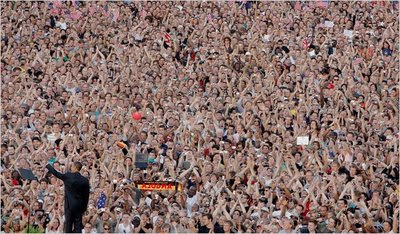 Senator Obama addressing a rally in Berlin, Germany on July 24, 2008. Almost ~200,000 Germans showed up. Photo: Jae C. Hong/Associated Press
- Economy: Senator Obama's economic policies, in my opinion, are more progressive and will achieve a greater balance in creating opportunities and wealth for everyone. Relying solely on the free markets to affect the trickle-down economic benefits has simply not worked. U.S. is the richest country in the world, but while the growth in the U.S economy over the years has been impressive, the fruits of this wealth have not benefited everyone equally. There is now almost an universal acknowledgment that our nation (and planet) are pulling apart economically. The divide between rich and poor has been growing dramatically over the past several decades. By some measure, in real-terms (adjusting for inflation), poor have actually become poorer. If we look at the total wealth, the richest 1% of U.S. households now owns 34.3% of the nation's private wealth, more than the combined wealth of the bottom 90%.
 Source: Economic Policy Institute, State of Working America 2006-07, Table 5.1, citing Wolff (2006).
- Stronger American democracy: The right to vote is probably one of the most important fundamental rights for citizens in a democracy. This is one time when they get a chance to ensure that folks setting and administering policies in their society represent its citizens' interests. However, almost half of the total eligible voters in the U.S. typically do not vote. They don't feel their politicians work for them anymore, and have somewhat lost faith in their government. Senator Obama has energized the masses and provided hope to millions of citizens across the country like not seen in decades. We've witnessed massive surge in new voter registrations all over the country. The picture is especially encouraging amongst young voters, who represent the country's future, and had historically been more dis-enchanted with the electoral process. Higher voter turnout during elections will ensure that the elected President and Congress members represent a greater proportion of our population. This will go a long way in strengthening the U.S. democracy even further.
I lived in the largest democracy in the world (India) for over twenty years before moving to the most effective democracy in the world (U.S.) thirteen years back. This country has provided me tremendous opportunities, and I proudly chose to become a U.S. citizen last year. I am looking forward to casting my first vote in America on Tuesday. I want this government to work for me. I'm sure you also want the same. I therefore urge you to go out, and cast your ballot on Tuesday. If you don't, you lose your right to complain if your leaders disappoint you in how they run the country.
October 26, 2008
"Wassup" guys are back - From beer to Obama
The characters that starred in "Wassup," the hit Budweiser beer ad campaign from 1999 that boosted its sales and also added a new phrase in the global pop-culture lexicon, are back. However, instead of beer, this time their video is promoting Barack Obama's U.S. presidential bid.
The parody video, created by Charles Stone III, who conceived the original Budweiser ads, was posted on YouTube two days back, and is already on its way to become a viral hit.
This is what creators have to say about their new video:
The original Budweiser commercial is below:
Budweiser's maker Anheuser-Busch and its ad agency, Omnicom Group's DDB Chicago, may be in a quandary because they cannot do much to stop the new video's distribution. Neither of them own the "Wassup" concept or the slogan. The brewer paid Charles Stone ~$37,000 to license the idea for five years, and signed him up to direct and appear with his buddies in the Budweiser Wassup commercials, which went on to win several awards. That deal expired three years ago.
The parody video, created by Charles Stone III, who conceived the original Budweiser ads, was posted on YouTube two days back, and is already on its way to become a viral hit.
This is what creators have to say about their new video:
Its been eight long years since the boys said wassup to each other. Even with the effects of a down economy and imminent change in the White House, the boys are still able to come together and stay true to what really matters.The video is posted below:
The original Budweiser commercial is below:
Budweiser's maker Anheuser-Busch and its ad agency, Omnicom Group's DDB Chicago, may be in a quandary because they cannot do much to stop the new video's distribution. Neither of them own the "Wassup" concept or the slogan. The brewer paid Charles Stone ~$37,000 to license the idea for five years, and signed him up to direct and appear with his buddies in the Budweiser Wassup commercials, which went on to win several awards. That deal expired three years ago.
October 24, 2008
As live sports on the Internet gain momentum, cricket can provide some pointers
2008 will be remembered as a banner year for live sports streaming on the Internet. Future looks promising as both the user demand and the profit potential seem to have crossed critical thresholds.
Since TV networks don't add to their production costs by simulcasting the coverage online, eyeballs picked up online are incremental gravy for their advertisers. Networks are also convinced that online simulcast won't cannibalize the big bucks tied up in TV, figuring you'll watch online only if you can't get to a TV set, or you'll log on as you watch TV.
Sports programmers therefore want to provide an answer to their fans' demand and keep up with the surge in user consumption of TV broadcast online. The Conference Board/TNS research show that about 20% of U.S. Internet households now watch online TV broadcasts — double the 2006 level.
Here are some major live sporting events streamed online this year and associated metrics, where available:
While most of the above initiatives are recent, cricket, one of the most obscure sports for American and most European sports fans, has been using Internet to reach its TV-coverage-starved fans globally for almost ten years now.
I am one of those fans. I first started watching live cricket online back in 1998, and Internet remains my primary source for live cricket even today.
In 1998, cricket was one of the reasons why I opted to participate as a trial customer for @Home's broadband rollout in Connecticut. Remember @Home, the broadband ISP that was hailed as the "new media network for the 21st century" after its $6.7Bn merger with the portal Excite in 1999. Excite@Home became bankrupt two years later, another example of a failed merger due to mismatch in the management cultures of the two firms and horribly executed integration.
I've been a close, first-hand witness of the improvement in cricket's live online streaming experience over the past ten years.
During the late nineties, even though I was on broadband, live cricket streaming provided a ton of buffering and a start/stop experience. There were no quality branded service providers that carried rights for online cricket in the U.S. I probably was using one of the online "hack-services" to buy cricket packages, because there were no easy alternatives available. Cricket was obviously not shown on the broadcast/cable TV in the U.S., and the only available satellite option from Dish Networks required installing a separate dish that had to point to its satellite providing international programming - if you wanted regular U.S. TV channels, a second dish pointing to a different satellite was needed. I could not install one, leave-alone two dishes, because my landlord objected to dishes hanging out from balconies. On one occasion when the landlord conceded, sympathetic to my passion for the game, I could not get a clear line-of-sight to Dish Network's international satellite from my balcony.
The Internet helped fill this market gap in 2003, when Willow TV, a Sunnywale, CA based startup was launched by, you guessed it, a bunch of Indian immigrants. Willow TV provides live streams of cricket matches on a pay-per-view or subscription basis. I've been a regular customer of Willow TV since the company's inception.

Willow TV has gradually acquired the live online streaming rights for small markets (e.g., U.S., Canada, etc.) from international cricket boards, for whom it was all incremental revenue, providing no conflict with their existing TV deals which were limited to big cricket markets. Last year, the site carried over 90% of the cricket matches live. It has over one million registered users, almost 75% of them in North America.
The company has apparently been profitable from the very beginning. Because the size of its target audience is relatively small in the markets Willow TV operates, the ad-supported free streaming business model is not feasible. The niche and ethnic nature of the audience also limits the type and number of advertisers that may be interested in reaching them specifically. Willow has therefore only operated on a pay-per-view or subscription basis. Packages range from $5 per game up to $200 for a series. Streaming is offered from 400 kbps to 700 kbps levels, and they apparently have plans to increase that to 1MBps next year.
I've seen their technology improve over the past five years, with almost TV-like experience today. I hook up my laptop to my 42" plasma when I'm watching at home. I'm also able to place-shift my package and watch live cricket while I'm on the road - the main reason why I don't buy TV packages from Dish Networks and DirecTV, both of which have now started offering pay-per-view cricket packages.
With the introduction of Twenty20, a shorter version of cricket launched to expand its popularity and adoption (game finishes in 2.5 to 3 hrs), and the mega success of the Indian Premier League, the inaugural domestic Twenty20 competition in India earlier this year, cricket is taking off globally in a major way. Reliance ADA, the largest media company in India, therefore made a swift strategic move in investing $60 to $70MM for a 75% stake in Willow TV. Elsewhere, ESPN paid almost $1Bn for the global rights to the Twenty20 Champions League, the world's richest cricket competition, in a 10-year deal.
As live sports streaming on the Internet becomes mainstream, cricket, with over ten years of experience, can definitely provide lessons on successful business models, targeting niche fans and satisfying their needs in a manner that is complimentary to TV broadcast, which will remain the primary revenue generator in sports for the foreseeable future.
Since TV networks don't add to their production costs by simulcasting the coverage online, eyeballs picked up online are incremental gravy for their advertisers. Networks are also convinced that online simulcast won't cannibalize the big bucks tied up in TV, figuring you'll watch online only if you can't get to a TV set, or you'll log on as you watch TV.
Sports programmers therefore want to provide an answer to their fans' demand and keep up with the surge in user consumption of TV broadcast online. The Conference Board/TNS research show that about 20% of U.S. Internet households now watch online TV broadcasts — double the 2006 level.
Here are some major live sporting events streamed online this year and associated metrics, where available:
- Beijing Olympics: The summer Olympics this year will be distinguished by, among other things, the first truly digital games in its history. In the U.S., NBC, the exclusive rights holder, recorded 1.3 billion page views, 53MM unique users, 75.5MM video streams, and approximately 10MM hours of total video consumed online. Metrics from other countries were equally impressive:
In Europe, over 30 EBU broadcasters offered Olympic content on their respective websites, complemented by the EBU aggregated live video portal www.eurovisionsports.tv/olympics, which delivered over 180 million broadband video streams, primarily generated by live event viewing to a unique audience of over 51 million, with a cumulative total of over 22 million hours viewed.
In China, over the 17 days of the Olympic Games, 153 million people watched live broadcast of the Olympic Games online, with 237 million watching video-on-demand footage and an average 20 million page views per day on the mobile phone platform provided by CCTV.com.
In Latin America, rights holder Terra made 13 online channels available to allow subscribers to choose which events to watch with over 300 hours of available action from all competitions. Terra's Olympic site registered 29 million video streams and over 10 million video-on-demand downloads over the period of the Games.
In Australia, since the Games began, over 32 million page views have been seen by over 2.3 million users, with more than 4 million live and on-demand videos streams watched on Yahoo!7 Olympics.
- March Madness: 4.8MM unique visitors throughout the two-week U.S. college basketball tournament streamed live by CBS.
- U.S. Open Golf Finals: 5.2MM streams were served by NBC and the USGA, spurred by Tiger Woods’ down-to-the-wire victory in the playoff that got pushed to Monday - most of these viewers were therefore watching online at work.
- Wimbledon: 1MM live streams and 4MM video-on-demand streams.
- Pocono 500: 712,000 streams were watched at NASCAR.com.
- National Basketball Association Western Conference Finals: 3MM live streams were served by TNT.
- Major League Baseball: 1.0 to 1.5MM viewers watch a live game each day.
- National Football League: NFL, the biggest and the most popular sports league in the U.S., in partnership with its broadcasting partner NBC Sports, has for the first time started streaming 17 regular-season games live on the Internet in the U.S. this season that started last month.
- National Hockey League: Earlier this month, NHL launched NHL GameCenter Live, its new online subscription service that stream live NHL games. Available for $159 for the whole season, or in monthly installments of $19.95, the service is targeted at avid fans as well as, per NHL, nearly 50% of fans who live away from their favorite team's local television market and therefore do not have access to some games on the TV. GameCenter Live does have some blackout restrictions, but allows users to view up to four games at once, choose from multiple camera angles, check stats and chat with one another.
While most of the above initiatives are recent, cricket, one of the most obscure sports for American and most European sports fans, has been using Internet to reach its TV-coverage-starved fans globally for almost ten years now.
I am one of those fans. I first started watching live cricket online back in 1998, and Internet remains my primary source for live cricket even today.
In 1998, cricket was one of the reasons why I opted to participate as a trial customer for @Home's broadband rollout in Connecticut. Remember @Home, the broadband ISP that was hailed as the "new media network for the 21st century" after its $6.7Bn merger with the portal Excite in 1999. Excite@Home became bankrupt two years later, another example of a failed merger due to mismatch in the management cultures of the two firms and horribly executed integration.
I've been a close, first-hand witness of the improvement in cricket's live online streaming experience over the past ten years.
During the late nineties, even though I was on broadband, live cricket streaming provided a ton of buffering and a start/stop experience. There were no quality branded service providers that carried rights for online cricket in the U.S. I probably was using one of the online "hack-services" to buy cricket packages, because there were no easy alternatives available. Cricket was obviously not shown on the broadcast/cable TV in the U.S., and the only available satellite option from Dish Networks required installing a separate dish that had to point to its satellite providing international programming - if you wanted regular U.S. TV channels, a second dish pointing to a different satellite was needed. I could not install one, leave-alone two dishes, because my landlord objected to dishes hanging out from balconies. On one occasion when the landlord conceded, sympathetic to my passion for the game, I could not get a clear line-of-sight to Dish Network's international satellite from my balcony.
The Internet helped fill this market gap in 2003, when Willow TV, a Sunnywale, CA based startup was launched by, you guessed it, a bunch of Indian immigrants. Willow TV provides live streams of cricket matches on a pay-per-view or subscription basis. I've been a regular customer of Willow TV since the company's inception.

Willow TV has gradually acquired the live online streaming rights for small markets (e.g., U.S., Canada, etc.) from international cricket boards, for whom it was all incremental revenue, providing no conflict with their existing TV deals which were limited to big cricket markets. Last year, the site carried over 90% of the cricket matches live. It has over one million registered users, almost 75% of them in North America.
The company has apparently been profitable from the very beginning. Because the size of its target audience is relatively small in the markets Willow TV operates, the ad-supported free streaming business model is not feasible. The niche and ethnic nature of the audience also limits the type and number of advertisers that may be interested in reaching them specifically. Willow has therefore only operated on a pay-per-view or subscription basis. Packages range from $5 per game up to $200 for a series. Streaming is offered from 400 kbps to 700 kbps levels, and they apparently have plans to increase that to 1MBps next year.
I've seen their technology improve over the past five years, with almost TV-like experience today. I hook up my laptop to my 42" plasma when I'm watching at home. I'm also able to place-shift my package and watch live cricket while I'm on the road - the main reason why I don't buy TV packages from Dish Networks and DirecTV, both of which have now started offering pay-per-view cricket packages.
With the introduction of Twenty20, a shorter version of cricket launched to expand its popularity and adoption (game finishes in 2.5 to 3 hrs), and the mega success of the Indian Premier League, the inaugural domestic Twenty20 competition in India earlier this year, cricket is taking off globally in a major way. Reliance ADA, the largest media company in India, therefore made a swift strategic move in investing $60 to $70MM for a 75% stake in Willow TV. Elsewhere, ESPN paid almost $1Bn for the global rights to the Twenty20 Champions League, the world's richest cricket competition, in a 10-year deal.
As live sports streaming on the Internet becomes mainstream, cricket, with over ten years of experience, can definitely provide lessons on successful business models, targeting niche fans and satisfying their needs in a manner that is complimentary to TV broadcast, which will remain the primary revenue generator in sports for the foreseeable future.
October 17, 2008
Internet radio is the sole bright spot in the declining radio industry
Radio industry in the U.S. has been in a decline phase for some time now. Listeners, specially younger ones under 35 yrs. of age, have less reasons to tune in amidst a plethora of choices. The broadcast radio has pushed them away with one bad decision after another that has led to diminishing quality in programming, songs, and commercials.
Any recovery in the radio business will need to understand the potential of digital media, adjust programming for today's consumer, and deliver to advertisers something that is unique and very different from what they've received in the past.
Digital media has been the only silver lining for the radio industry. Internet radio has seen impressive growth in both audience and advertising over the past five years. Ability to target and track ads online vs. terrestrial radio is the obvious reason for increased advertiser interest. While at AOL, I was involved in launching one of the largest radio service on the Internet with a base of ~14M monthly listeners through a partnership between AOL Radio and XM Satellite Radio. AOL recently ended that XM relationship and replaced it with a broader deal with CBS Radio. The AOL/CBS deal also brought together synergies for both party's advertising inventory and streaming ad sales partners. TargetSpot, a CBS-backed startup that sells targeted local advertising for online-radio stations, and Ronning Lipset Radio, AOL's partner for over four years that sells national advertising, gained access to the combined AOL/CBS inventory.
According to yesterday's Wall Street Journal, TargetSpot has acquired Ronning Lipset Radio. The deal makes sense because the two companies bring complimentary capabilities to the table (local plus national advertising). Additionally, increased scale will help TargetSpot to better capitalize on the fast growing mobile advertising market. Its audio advertising solutions will be highly relevant & effective for streaming radio services for mobile devices, whose popularity will only increase with the full rollout of the 3G network, increase in the number of streaming mobile devices and their adoption.
I've included some numbers on the radio industry's advertising figures from the WSJ article.
The detailed full-year industry revenue comparison for 2007 vs. 2006 from the Radio Advertising Bureau can be found here.
Any recovery in the radio business will need to understand the potential of digital media, adjust programming for today's consumer, and deliver to advertisers something that is unique and very different from what they've received in the past.
Digital media has been the only silver lining for the radio industry. Internet radio has seen impressive growth in both audience and advertising over the past five years. Ability to target and track ads online vs. terrestrial radio is the obvious reason for increased advertiser interest. While at AOL, I was involved in launching one of the largest radio service on the Internet with a base of ~14M monthly listeners through a partnership between AOL Radio and XM Satellite Radio. AOL recently ended that XM relationship and replaced it with a broader deal with CBS Radio. The AOL/CBS deal also brought together synergies for both party's advertising inventory and streaming ad sales partners. TargetSpot, a CBS-backed startup that sells targeted local advertising for online-radio stations, and Ronning Lipset Radio, AOL's partner for over four years that sells national advertising, gained access to the combined AOL/CBS inventory.
According to yesterday's Wall Street Journal, TargetSpot has acquired Ronning Lipset Radio. The deal makes sense because the two companies bring complimentary capabilities to the table (local plus national advertising). Additionally, increased scale will help TargetSpot to better capitalize on the fast growing mobile advertising market. Its audio advertising solutions will be highly relevant & effective for streaming radio services for mobile devices, whose popularity will only increase with the full rollout of the 3G network, increase in the number of streaming mobile devices and their adoption.
I've included some numbers on the radio industry's advertising figures from the WSJ article.
U.S. advertising revenue in general will probably shrink 0.8% this year, says Wachovia analyst John Janedis. The radio industry seems on track for an even worse performance. Local spot radio advertising revenue, the medium's bread-and- butter, has declined every month this year compared with a year earlier, with August's decline reaching 11%, according to the Radio Advertising Bureau.
Last week, CBS Corp., one of the nation's largest radio-station owners, revised its full-year business outlook because of declining advertising.
But online radio advertising -- much of it the audio ads listeners hear when they tune into a station on the Internet -- is rising at a double-digit pace. Last year, radio sold $21.3 billion in advertising, including about $1.7 billion in the "off air" category that is chiefly online advertising.
The detailed full-year industry revenue comparison for 2007 vs. 2006 from the Radio Advertising Bureau can be found here.
October 14, 2008
Republicans' desperate tactics will be counter-productive
Two leading national polls this week show Barack Obama, the Democratic U.S. presidential candidate, widening his lead over the Republican candidate John McCain. Obama is ahead by 14% (53% to 39%) in a New York Times/CBS News poll, and by 9% (50% to 41%) in a Los Angeles Times/Bloomberg poll.
The McCain campaign, in a desperate effort to halt the slide, has unfortunately adopted tactics to instill fear/hate amongst voters for Obama, as opposed to convincing them why they should prefer McCain. Below is a picture from a McCain-Palin rally in Virgina this week. Their supporters are holding signs to suggest an equivalence between Obama and the Islamic terrorists responsible for the brutal 9/11 attacks in the U.S. This is extremely deplorable.
 Source: Chip Somodevilla/AFP/Getty
I doubt such fear tactics, which unfortunately became mainstream during the current Bush administration, are going to work. A message of hope and optimism, especially during the current economic gloom and doom, is what voters need. If the McCain campaign continues down this path, and does not instead focus on selling how their candidate is better than Barack Obama on critical policy issues, we may see the Democratic lead widening even further.
The McCain campaign, in a desperate effort to halt the slide, has unfortunately adopted tactics to instill fear/hate amongst voters for Obama, as opposed to convincing them why they should prefer McCain. Below is a picture from a McCain-Palin rally in Virgina this week. Their supporters are holding signs to suggest an equivalence between Obama and the Islamic terrorists responsible for the brutal 9/11 attacks in the U.S. This is extremely deplorable.
 Source: Chip Somodevilla/AFP/Getty
I doubt such fear tactics, which unfortunately became mainstream during the current Bush administration, are going to work. A message of hope and optimism, especially during the current economic gloom and doom, is what voters need. If the McCain campaign continues down this path, and does not instead focus on selling how their candidate is better than Barack Obama on critical policy issues, we may see the Democratic lead widening even further.
October 1, 2008

September 30, 2008
Today's Wall Street crash
Quote of the day:
The U.S. House of Representatives today rejected the $700 billion financial rescue plan, resulting in the Dow plummeting by 777 points, its largest single-day drop ever. The market lost $1.2 trillion in value. Just 1/3rd of Republicans voting backed the plan, which was proposed by their own President Bush.
Part of the reason for the failure in my opinion was wrong messaging. The rescue package was treated as a bailout for the wealthy Wall Street bankers at the expense of taxpayers. This is not entirely true. Credit squeeze due to toxic mortgage assets on the balance sheet of banks will affect the common person, at some level, more than wealthy bankers who have resources available for a rainy day. If banks freeze their lending, it'll impact car loans, small business loans, college tuition loans, and may also cause serious layoffs as firms cut projects due to capital shortage.
I believe some sort of rescue plan will be passed eventually. But the Federal rescue package in itself, though required, does not guarantee a sustainable recovery. My fear is that the American financial turmoil would spread over to Europe, which seems to be where the U.S. was a year back, and maybe the rest of the world. Though several emerging economies (BRIC nations) have domestic markets to sustain some of their growth - the "de-coupling" theory between developed and developing world markets that economists talk about - America and Europe are still the primary drivers of the global economy. If they sneeze, rest of the world will catch cold. U.S. mortgage-backed securities also found their way into the books of several global banks, not just those of Wall St firms. And many European banks are just too big for their individual governments to be able to bail them out. And a pan-European rescue, existence of the European Central Bank & European Union structure notwithstanding, would be extremely difficult due to the complexity of working through different regulations and political issues of individual countries.
Japan took more than two decades to recover from its similar real estate collapse driven economic meltdown of the 80s. I suspect U.S. will face the same fate, but we're clearly entering a highly uncertain economic environment.
“This is a huge cow patty with a piece of marshmallow stuck in the middle of it and I am not going to eat that cow patty,” said Representative Paul Broun, Republican of Georgia.
The U.S. House of Representatives today rejected the $700 billion financial rescue plan, resulting in the Dow plummeting by 777 points, its largest single-day drop ever. The market lost $1.2 trillion in value. Just 1/3rd of Republicans voting backed the plan, which was proposed by their own President Bush.
Part of the reason for the failure in my opinion was wrong messaging. The rescue package was treated as a bailout for the wealthy Wall Street bankers at the expense of taxpayers. This is not entirely true. Credit squeeze due to toxic mortgage assets on the balance sheet of banks will affect the common person, at some level, more than wealthy bankers who have resources available for a rainy day. If banks freeze their lending, it'll impact car loans, small business loans, college tuition loans, and may also cause serious layoffs as firms cut projects due to capital shortage.
I believe some sort of rescue plan will be passed eventually. But the Federal rescue package in itself, though required, does not guarantee a sustainable recovery. My fear is that the American financial turmoil would spread over to Europe, which seems to be where the U.S. was a year back, and maybe the rest of the world. Though several emerging economies (BRIC nations) have domestic markets to sustain some of their growth - the "de-coupling" theory between developed and developing world markets that economists talk about - America and Europe are still the primary drivers of the global economy. If they sneeze, rest of the world will catch cold. U.S. mortgage-backed securities also found their way into the books of several global banks, not just those of Wall St firms. And many European banks are just too big for their individual governments to be able to bail them out. And a pan-European rescue, existence of the European Central Bank & European Union structure notwithstanding, would be extremely difficult due to the complexity of working through different regulations and political issues of individual countries.
Japan took more than two decades to recover from its similar real estate collapse driven economic meltdown of the 80s. I suspect U.S. will face the same fate, but we're clearly entering a highly uncertain economic environment.
September 29, 2008
Tracking Chrome's adoption
 Google launched its Web browser Chrome, one of its most important products ever, on September 2, 2008. As users study and test Chrome's features, I'm going to regularly start tracking its user adoption over two-week periods using the browser traffic source to my blog.
For the first data point, I'm picking the two-week period starting one week after the Chrome was launched. Chrome has already gained a 3.4% browser market share amongst my blog's readers. Since most of them obviously belong to the digital media/consumer Internet industry, they're expected to be early adopters. Still, I think these results are impressive. We'll see if Chrome's numbers are sustainable.
Percentage, by browsers, of the total visits to this blog
Period: Sept 9, 2008 - Sept 22, 2008
- Firefox 61.0%
- Internet Explorer 30.5%
- Chrome 3.4%
- Safari 1.7%
- Others 3.4%
 Source: Net Applications, August 2008
Subscribe to:
Posts (Atom)