November 8, 2008

America is ready for a revolution...

As my plane landed in New York at ~5:00AM today after a red-eye flight back from San Francisco, I opened my eyes and looked through the window. It suddenly sank through what this nation, and the world, had witnessed this week. The Unites States of America had overwhelming elected a black man named Barack Hussein Obama as its next president. I was indeed looking at the dawn of a new era.

On Tuesday night, while packing for my next day's early morning flight to San Francisco, I was twittering away as poll results started trending decisively towards Obama by 9:30PM. I went to bed after my last twitter at 11:03PM - Obama wins! Take a moment to reflect - history is made today!! It was however me who did not get a chance to reflect amidst the last three days of meetings and the Web 2.0 Summit in San Francisco. Until this morning.

Senator Obama's landslide victory is historic and a source of much needed hope on several counts, but I'll let the press and political historians ponder through that. Many feel that the most significant outcome of the Obama Presidency will be the final end of America's Civil Rights movement. I'm not so sure about that. I think Obama's victory is mostly a symbolic proof of the change on the race front that has already been happening in the U.S. for the past several decades. Today, for most part, race is a non-issue for the majority of Americans. The three main reasons why I supported Obama did not include race. Tom Friedman argued the same in his Op-Ed column in The New York Times after the victory. He wrote:
"But my gut tells me that of all the changes that will be ushered in by an Obama presidency, breaking with our racial past may turn out to be the least of them."
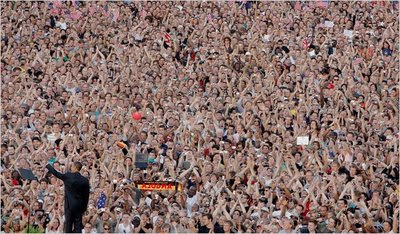
My biggest fear now is the loss of the momentum after Obama's victory. The momentum amongst millions of citizens who came out to vote for the first time, hoping for a change, and willing to devote their time, energy, and even careers. The work has just started. That is probably the reason why I thought President-elect Obama was so somber in his victory address Tuesday night at the Grant Park in Chicago (below is the video). While almost quarter of a million Americans cheered and celebrated (some in tears), there were hardly any triumphant or festive signs in Obama's tone or gestures as he delivered an inspiring speech. He apparently canceled the fireworks planned at the Park. The weight of all the expectations and the responsibilities ahead probably robbed Obama of even a brief moment of public celebration with his supporters after a historic victory.


I think this country is ready for a revolution - led by young and old who hope for a change, and want to live a purpose-driven life. The crumbling of the rampant greed-driven, unfettered free market-spurred, investment banking industry (more on that later) is watched by young Americans who are getting ready to make their career choices. A message of hope, inspired by a young leader, is reverberating through the air at the same time. Several long-impacting, critical issues loom in front of them (environment, energy, economy, terrorism, etc.). I think a perfect storm is brewing...the groundwork is done, and the recipe for change is there. Time has come to lay out the mission.

I heard Al Gore speak last evening at the Web 2.0 Summit in San Francisco. He provided an interesting factoid. When President John F. Kennedy presented a bold challenge to the American people forty seven years ago - America should, within that decade, land a man on the moon and return him safely home - many derided the dream as lunacy. Eight years later when Neil Armstrong stepped on the surface of the moon, the team that cheered the achievement at the Houston mission control center had an average age of 26 years. Many of those engineers were less than 18 years old when JFK inspired them to "dream" the moon mission in 1961. That's what leaders do.

President-elect Obama, who has often been compared to JFK, needs to now lay out the mission for his eager "troops," who are thirsty to make a difference.

November 4, 2008

Election day

Today is election day. Please vote.

We just got back home after voting at Ward 1, District 1-2 in West New York. They had moved the election booth at the last minute from its original location (a school) to the lobby of a high-rise apartment building across the street, so it took us a bit to locate it. But otherwise the process was smooth. As newly minted U.S. citizens, we were voting for the first time, but we found the new electronic voting machines pretty simple to use. They could have however posted clear, step-wise, voting instructions at the top of the machine inside the booth. But they had a helper standing right outside each booth for any questions.

We were in and out in ~20 minutes. I'm not an early morning person, but I think going early was a good idea...no lines.


November 2, 2008

SNL continues to deliver - John McCain & Sarah Palin (Fey)

It's safe to say that the U.S. Presidential election campaign has been the biggest reality show on the TV over the past few months. All three Presidential debates, the sole Vice Presidential debate, Senator Barack Obama's 30-min, prime-time TV commercial this past Wednesday, and candidates' appearances, interviews and sketches during various talk shows have all achieved unprecedented ratings bonanza compared to those from previous elections. These shows have also beaten ratings of regular entertainment TV programming during the same time slots.

No other show in my opinion has benefited more than the Saturday Night Live, a cultural & comedy icon whose ratings otherwise have been on the decline for past several years. Presidential elections, a new breed of talented writers, and Tina Fey have catapulted SNL to a point where it has a perfect opportunity to regain its lost glory in a sustainable manner well beyond the elections. Tina Fey's SNL sketches mimicking Governor Sarah Palin, the Republican Vice Presidential nominee, have been instant hits on the Internet almost every single weekend.

Below is the sketch from yesterday's SNL. It's hilarious. I wish Senator John McCain looked this relaxed during his entire campaign.


Here are my few other favorite election-themed SNL clips.

Gov. Palin and Senator Clinton address the nation:


Gov. Palin and Katie Couric get real and adorable:


Governor Palin pays a visit to SNL:


President Bush endorses McCain and Palin:

November 1, 2008

U.S. Presidential election - I support Barack Obama

Readers of this blog must have guessed it by now that I support Senator Barack Obama to become the next President of the United States. If not, here is my unambiguous support for his candidacy.


The 2008 U.S. Presidential election, and the last 21 months of campaigning by the two major parties, has been truly historic for several reasons. Millions of voters participated in an unprecedented Democratic party primary. And now, history will be made irrespective of who wins the election on Tuesday, Nov. 4th. We'll either have the first-ever African-American President in the U.S., or its first-ever female Vice President.

The great news is that even if the Republican candidate Senator John McCain wins, which is looking increasingly unlikely, we'll be better off than the last eight years of his party's U.S. presidency under President George W. Bush.

I guess candidates during every U.S. Presidential election claim that "stakes are the highest," but I truly believe it is true this time. While I support Obama's candidacy for several reasons, here are the three most important ones:
  • Foreign policy: Today we live in a global, connected village, where several aspects of our daily lives can be impacted by decisions taken thousands of miles away in countries on the other side of the planet. The ongoing global financial crisis provides a perfect example of this phenomenon. Senator Obama's foreign policies, temperament, and deliberative approach are the best hope for America to regain the admiration and leadership this country enjoyed throughout the world before September 11, 2001. There were always differences on specific issues, but overall, U.S. enjoyed a very positive image globally, which unfortunately has taken a severe beating during the last eight years of President Bush's administration. America remains the sole super power on the earth, and is also its largest economy. It therefore has the opportunity to be a global leader on critical issues whose impact go beyond national boundaries. With leadership and power, however, comes the responsibility. Even though Senator McCain has better foreign policy credentials and clear advantage in experience over Senator Obama, it's Obama who got widespread endorsements worldwide, not just by global leaders but also by the masses. I believe Obama is the better candidate to heal relations and be the real change agent the world needs at this crucial hour when we're going through a severe global financial crisis, energy shortage, rising food prices, spreading terrorism, and an environmental catastrophe.
Senator Obama addressing a rally in Berlin, Germany on July 24, 2008. Almost ~200,000 Germans showed up. Photo: Jae C. Hong/Associated Press
  • Economy: Senator Obama's economic policies, in my opinion, are more progressive and will achieve a greater balance in creating opportunities and wealth for everyone. Relying solely on the free markets to affect the trickle-down economic benefits has simply not worked. U.S. is the richest country in the world, but while the growth in the U.S economy over the years has been impressive, the fruits of this wealth have not benefited everyone equally. There is now almost an universal acknowledgment that our nation (and planet) are pulling apart economically. The divide between rich and poor has been growing dramatically over the past several decades. By some measure, in real-terms (adjusting for inflation), poor have actually become poorer. If we look at the total wealth, the richest 1% of U.S. households now owns 34.3% of the nation's private wealth, more than the combined wealth of the bottom 90%.
Source: Economic Policy Institute, State of Working America 2006-07, Table 5.1, citing Wolff (2006).
  • Stronger American democracy: The right to vote is probably one of the most important fundamental rights for citizens in a democracy. This is one time when they get a chance to ensure that folks setting and administering policies in their society represent its citizens' interests. However, almost half of the total eligible voters in the U.S. typically do not vote. They don't feel their politicians work for them anymore, and have somewhat lost faith in their government. Senator Obama has energized the masses and provided hope to millions of citizens across the country like not seen in decades. We've witnessed massive surge in new voter registrations all over the country. The picture is especially encouraging amongst young voters, who represent the country's future, and had historically been more dis-enchanted with the electoral process. Higher voter turnout during elections will ensure that the elected President and Congress members represent a greater proportion of our population. This will go a long way in strengthening the U.S. democracy even further.

I lived in the largest democracy in the world (India) for over twenty years before moving to the most effective democracy in the world (U.S.) thirteen years back. This country has provided me tremendous opportunities, and I proudly chose to become a U.S. citizen last year. I am looking forward to casting my first vote in America on Tuesday. I want this government to work for me. I'm sure you also want the same. I therefore urge you to go out, and cast your ballot on Tuesday. If you don't, you lose your right to complain if your leaders disappoint you in how they run the country.

October 26, 2008

"Wassup" guys are back - From beer to Obama

The characters that starred in "Wassup," the hit Budweiser beer ad campaign from 1999 that boosted its sales and also added a new phrase in the global pop-culture lexicon, are back. However, instead of beer, this time their video is promoting Barack Obama's U.S. presidential bid.

The parody video, created by Charles Stone III, who conceived the original Budweiser ads, was posted on YouTube two days back, and is already on its way to become a viral hit.

This is what creators have to say about their new video:
Its been eight long years since the boys said wassup to each other. Even with the effects of a down economy and imminent change in the White House, the boys are still able to come together and stay true to what really matters.
The video is posted below:


The original Budweiser commercial is below:


Budweiser's maker Anheuser-Busch and its ad agency, Omnicom Group's DDB Chicago, may be in a quandary because they cannot do much to stop the new video's distribution. Neither of them own the "Wassup" concept or the slogan. The brewer paid Charles Stone ~$37,000 to license the idea for five years, and signed him up to direct and appear with his buddies in the Budweiser Wassup commercials, which went on to win several awards. That deal expired three years ago.

October 24, 2008

As live sports on the Internet gain momentum, cricket can provide some pointers

2008 will be remembered as a banner year for live sports streaming on the Internet. Future looks promising as both the user demand and the profit potential seem to have crossed critical thresholds.

Since TV networks don't add to their production costs by simulcasting the coverage online, eyeballs picked up online are incremental gravy for their advertisers. Networks are also convinced that online simulcast won't cannibalize the big bucks tied up in TV, figuring you'll watch online only if you can't get to a TV set, or you'll log on as you watch TV.

Sports programmers therefore want to provide an answer to their fans' demand and keep up with the surge in user consumption of TV broadcast online. The Conference Board/TNS research show that about 20% of U.S. Internet households now watch online TV broadcasts — double the 2006 level.

Here are some major live sporting events streamed online this year and associated metrics, where available:

  • Beijing Olympics: The summer Olympics this year will be distinguished by, among other things, the first truly digital games in its history. In the U.S., NBC, the exclusive rights holder, recorded 1.3 billion page views, 53MM unique users, 75.5MM video streams, and approximately 10MM hours of total video consumed online. Metrics from other countries were equally impressive:

In Europe, over 30 EBU broadcasters offered Olympic content on their respective websites, complemented by the EBU aggregated live video portal www.eurovisionsports.tv/olympics, which delivered over 180 million broadband video streams, primarily generated by live event viewing to a unique audience of over 51 million, with a cumulative total of over 22 million hours viewed.

In China, over the 17 days of the Olympic Games, 153 million people watched live broadcast of the Olympic Games online, with 237 million watching video-on-demand footage and an average 20 million page views per day on the mobile phone platform provided by CCTV.com.

In Latin America, rights holder Terra made 13 online channels available to allow subscribers to choose which events to watch with over 300 hours of available action from all competitions. Terra's Olympic site registered 29 million video streams and over 10 million video-on-demand downloads over the period of the Games.

In Australia, since the Games began, over 32 million page views have been seen by over 2.3 million users, with more than 4 million live and on-demand videos streams watched on Yahoo!7 Olympics.

  • March Madness: 4.8MM unique visitors throughout the two-week U.S. college basketball tournament streamed live by CBS.
  • U.S. Open Golf Finals: 5.2MM streams were served by NBC and the USGA, spurred by Tiger Woods’ down-to-the-wire victory in the playoff that got pushed to Monday - most of these viewers were therefore watching online at work.
  • Wimbledon: 1MM live streams and 4MM video-on-demand streams.
  • Pocono 500: 712,000 streams were watched at NASCAR.com.
All the four major professional sports leagues in the U.S. have also jumped on the live online streaming bandwagon.
  • National Basketball Association Western Conference Finals: 3MM live streams were served by TNT.
  • Major League Baseball: 1.0 to 1.5MM viewers watch a live game each day.
  • National Football League: NFL, the biggest and the most popular sports league in the U.S., in partnership with its broadcasting partner NBC Sports, has for the first time started streaming 17 regular-season games live on the Internet in the U.S. this season that started last month.
  • National Hockey League: Earlier this month, NHL launched NHL GameCenter Live, its new online subscription service that stream live NHL games. Available for $159 for the whole season, or in monthly installments of $19.95, the service is targeted at avid fans as well as, per NHL, nearly 50% of fans who live away from their favorite team's local television market and therefore do not have access to some games on the TV. GameCenter Live does have some blackout restrictions, but allows users to view up to four games at once, choose from multiple camera angles, check stats and chat with one another.
I tested the NHL streaming (the season-opening weekend was free), and think their experience is pretty good because it leverages the uniqueness of the Internet medium in terms of its interactivity, social and non-linear nature.

While most of the above initiatives are recent, cricket, one of the most obscure sports for American and most European sports fans, has been using Internet to reach its TV-coverage-starved fans globally for almost ten years now.

I am one of those fans. I first started watching live cricket online back in 1998, and Internet remains my primary source for live cricket even today.

In 1998, cricket was one of the reasons why I opted to participate as a trial customer for @Home's broadband rollout in Connecticut. Remember @Home, the broadband ISP that was hailed as
the "new media network for the 21st century" after its $6.7Bn merger with the portal Excite in 1999. Excite@Home became bankrupt two years later, another example of a failed merger due to mismatch in the management cultures of the two firms and horribly executed integration.

I've been a close, first-hand witness of the improvement in cricket's live online streaming experience over the past ten years.

During the late nineties, even though I was on broadband, live cricket streaming provided a ton of buffering and a start/stop experience. There were no quality branded service providers that carried rights for online cricket in the U.S. I probably was using one of the online "hack-services" to buy cricket packages, because there were no easy alternatives available. Cricket was obviously not shown on the broadcast/cable TV in the U.S., and the only available satellite option from Dish Networks required installing a separate dish that had to point to its satellite providing international programming - if you wanted regular U.S. TV channels, a second dish pointing to a different satellite was needed. I could not
install one, leave-alone two dishes, because my landlord objected to dishes hanging out from balconies. On one occasion when the landlord conceded, sympathetic to my passion for the game, I could not get a clear line-of-sight to Dish Network's international satellite from my balcony.

The Internet helped fill this market gap in 2003, when
Willow TV, a Sunnywale, CA based startup was launched by, you guessed it, a bunch of Indian immigrants. Willow TV provides live streams of cricket matches on a pay-per-view or subscription basis. I've been a regular customer of Willow TV since the company's inception.


Willow TV has gradually acquired the live online streaming rights for small markets (e.g., U.S., Canada, etc.) from international cricket boards, for whom it was all incremental revenue, providing no conflict with their existing TV deals which were limited to big cricket markets. Last year, the site carried over 90% of the cricket matches live. It has over one million registered users, almost 75% of them in North America.

The company has apparently been profitable from the very beginning.
Because the size of its target audience is relatively small in the markets Willow TV operates, the ad-supported free streaming business model is not feasible. The niche and ethnic nature of the audience also limits the type and number of advertisers that may be interested in reaching them specifically. Willow has therefore only operated on a pay-per-view or subscription basis. Packages range from $5 per game up to $200 for a series. Streaming is offered from 400 kbps to 700 kbps levels, and they apparently have plans to increase that to 1MBps next year.

I've seen their technology improve over the past five years, with almost TV-like experience today. I hook up my laptop to my 42" plasma when I'm watching at home. I'm also able to place-shift my package and watch live cricket while I'm on the road - the main reason why I don't buy TV packages from Dish Networks and DirecTV, both of which have now started offering pay-per-view cricket packages.

With the introduction of Twenty20, a shorter version of cricket launched to expand its popularity and adoption (game finishes in 2.5 to 3 hrs), and the mega success of the Indian Premier League, the inaugural domestic Twenty20 competition in India earlier this year, cricket is taking off globally in a major way. Reliance ADA, the largest media company in India, therefore made a swift strategic move in investing $60 to $70MM for a 75% stake in Willow TV. Elsewhere, ESPN paid almost $1Bn for the global rights to the Twenty20 Champions League, the world's richest cricket competition, in a 10-year deal.

As live sports streaming on the Internet becomes mainstream, cricket, with over ten years of experience, can definitely provide lessons on successful business models, targeting niche fans and satisfying their needs in a manner that is complimentary to TV broadcast, which will remain the primary revenue generator in sports for the foreseeable future.

October 17, 2008

Internet radio is the sole bright spot in the declining radio industry

Radio industry in the U.S. has been in a decline phase for some time now. Listeners, specially younger ones under 35 yrs. of age, have less reasons to tune in amidst a plethora of choices. The broadcast radio has pushed them away with one bad decision after another that has led to diminishing quality in programming, songs, and commercials.

Any recovery in the radio business will need to understand the potential of digital media, adjust programming for today's consumer, and deliver to advertisers something that is unique and very different from what they've received in the past.

Digital media has been the only silver lining for the radio industry. Internet radio has seen impressive growth in both audience and advertising over the past five years. Ability to target and track ads online vs. terrestrial radio is the obvious reason for increased advertiser interest. While at AOL, I was involved in launching one of the largest radio service on the Internet with a base of ~14M monthly listeners through a partnership between AOL Radio and XM Satellite Radio. AOL recently ended that XM relationship and replaced it with a broader deal with CBS Radio. The AOL/CBS deal also brought together synergies for both party's advertising inventory and streaming ad sales partners. TargetSpot, a CBS-backed startup that sells targeted local advertising for online-radio stations, and Ronning Lipset Radio, AOL's partner for over four years that sells national advertising, gained access to the combined AOL/CBS inventory.

According to yesterday's Wall Street Journal, TargetSpot has acquired Ronning Lipset Radio. The deal makes sense because the two companies bring complimentary capabilities to the table (local plus national advertising). Additionally, increased scale will help TargetSpot to better capitalize on the fast growing mobile advertising market. Its audio advertising solutions will be highly relevant & effective for streaming radio services for mobile devices, whose popularity will only increase with the full rollout of the 3G network, increase in the number of streaming mobile devices and their adoption.

I've included some numbers on the radio industry's advertising figures from the WSJ article.
U.S. advertising revenue in general will probably shrink 0.8% this year, says Wachovia analyst John Janedis. The radio industry seems on track for an even worse performance. Local spot radio advertising revenue, the medium's bread-and- butter, has declined every month this year compared with a year earlier, with August's decline reaching 11%, according to the Radio Advertising Bureau.

Last week, CBS Corp., one of the nation's largest radio-station owners, revised its full-year business outlook because of declining advertising.

But online radio advertising -- much of it the audio ads listeners hear when they tune into a station on the Internet -- is rising at a double-digit pace. Last year, radio sold $21.3 billion in advertising, including about $1.7 billion in the "off air" category that is chiefly online advertising.

The detailed full-year industry revenue comparison for 2007 vs. 2006 from the Radio Advertising Bureau can be found here.

October 14, 2008

Republicans' desperate tactics will be counter-productive

Two leading national polls this week show Barack Obama, the Democratic U.S. presidential candidate, widening his lead over the Republican candidate John McCain. Obama is ahead by 14% (53% to 39%) in a New York Times/CBS News poll, and by 9% (50% to 41%) in a Los Angeles Times/Bloomberg poll.

The McCain campaign, in a desperate effort to halt the slide, has unfortunately adopted tactics to instill fear/hate amongst voters for Obama, as opposed to convincing them why they should prefer McCain. Below is a picture from a McCain-Palin rally in Virgina this week. Their supporters are holding signs to suggest an equivalence between Obama and the Islamic terrorists responsible for the brutal 9/11 attacks in the U.S. This is extremely deplorable.


Source: Chip Somodevilla/AFP/Getty

I doubt such fear tactics, which unfortunately became mainstream during the current Bush administration, are going to work. A message of hope and optimism, especially during the current economic gloom and doom, is what voters need. If the McCain campaign continues down this path, and does not instead focus on selling how their candidate is better than Barack Obama on critical policy issues, we may see the Democratic lead widening even further.

October 1, 2008

September 30, 2008

Today's Wall Street crash

Quote of the day:

“This is a huge cow patty with a piece of marshmallow stuck in the middle of it and I am not going to eat that cow patty,” said Representative Paul Broun, Republican of Georgia.

The U.S. House of Representatives today rejected the $700 billion financial rescue plan, resulting in the Dow plummeting by 777 points, its largest single-day drop ever. The market lost $1.2 trillion in value. Just 1/3rd of Republicans voting backed the plan, which was proposed by their own President Bush.

Part of the reason for the failure in my opinion was wrong messaging. The rescue package was treated as a bailout for the wealthy Wall Street bankers at the expense of taxpayers. This is not entirely true. Credit squeeze due to toxic mortgage assets on the balance sheet of banks will affect the common person, at some level, more than wealthy bankers who have resources available for a rainy day. If banks freeze their lending, it'll impact car loans, small business loans, college tuition loans, and may also cause serious layoffs as firms cut projects due to capital shortage.

I believe some sort of rescue plan will be passed eventually. But the Federal rescue package in itself, though required, does not guarantee a sustainable recovery. My fear is that the American financial turmoil would spread over to Europe, which seems to be where the U.S. was a year back, and maybe the rest of the world. Though several emerging economies (BRIC nations) have domestic markets to sustain some of their growth - the "de-coupling" theory between developed and developing world markets that economists talk about - America and Europe are still the primary drivers of the global economy. If they sneeze, rest of the world will catch cold. U.S. mortgage-backed securities also found their way into the books of several global banks, not just those of Wall St firms. And many European banks are just too big for their individual governments to be able to bail them out. And a pan-European rescue, existence of the European Central Bank & European Union structure notwithstanding, would be extremely difficult due to the complexity of working through different regulations and political issues of individual countries.

Japan took more than two decades to recover from its similar real estate collapse driven economic meltdown of the 80s. I suspect U.S. will face the same fate, but we're clearly entering a highly uncertain economic environment.

September 29, 2008

Tracking Chrome's adoption

Google launched its Web browser Chrome, one of its most important products ever, on September 2, 2008. As users study and test Chrome's features, I'm going to regularly start tracking its user adoption over two-week periods using the browser traffic source to my blog.

For the first data point, I'm picking the two-week period starting one week after the Chrome was launched. Chrome has already gained a 3.4% browser market share amongst my blog's readers. Since most of them obviously belong to the digital media/consumer Internet industry, they're expected to be early adopters. Still, I think these results are impressive. We'll see if Chrome's numbers are sustainable.

Percentage, by browsers, of the total visits to this blog
Period: Sept 9, 2008 - Sept 22, 2008

  1. Firefox 61.0%
  2. Internet Explorer 30.5%
  3. Chrome 3.4%
  4. Safari 1.7%
  5. Others 3.4%
To keep things in perspective, here is the global market share for browsers:

Source: Net Applications, August 2008

September 27, 2008

Quote of the day on Sarah Palin

Jimmy Kimmel:

"John McCain showed up (for the Washington DC meeting to discuss the financial rescue package) without running mate Sarah Palin, which is a shame because she actually has a lot of experience with financial matters. You know, she lives right next to a bank."

Kimmel obviously is doing his job as a comedian. People will however continue to poke fun at Palin's questionable qualifications as McCain's vice presidential nominee as long as she continues to outrageously claim that one of her main foreign policy credentials is the fact that she can see Russia from Alaska.

September 24, 2008

Scenes from India

The Boston Globe has tried to convey the spirit of India and its fascinating diversity through 34 pictures. While it's impossible to capture the essence of a huge and complex country like India in 34 pictures, these images are nevertheless impressive.

Few selected ones, mostly depicting the country's religious diversity, are below:


Devotees carry a statue of the Hindu elephant god Ganesh, the deity of prosperity, for immersion in the sea, on the last day of "Ganesh Chaturthi", in Mumbai September 14, 2008. Clay statues of Ganesh are made two to three months before this popular religious festival in India. The idols are taken through the streets in a procession accompanied with dancing and singing, to be immersed in a river symbolizing a ritual sendoff on his journey towards his home. (REUTERS/Punit Paranjpe).


Catholic nuns from the Missionaries of Charity order sing hymns for a special prayer during the eleventh anniversary of the death of Mother Teresa in the eastern Indian city of Kolkata September 5, 2008. Mother Teresa was a Nobel Peace Prize-winning nun who died in 1997, and was beatified by Pope John Paul II in 2003 at the Vatican. (REUTERS/Jayanta Shaw)


Hindu devotees, try to form a human pyramid to break an earthen pot filled with honey, milk and curd, as part of festivities to celebrate Janmashthmi, or the birth anniversary of Lord Krishna, in Mumbai, India, Sunday, Aug. 24, 2008. (AP Photo/Rajanish Kakade)


A view of the illuminated Golden Temple, Sikhs holiest shrine, in Amritsar, India, Monday, Sept. 1, 2008. This year, Sikhs mark the 404th anniversary of the installation of the Guru Granth Sahib, the sacred book of the Sikhs. (AP Photo/Aman Sharma)


Performers dressed as tigers take part in Pulikali, or tiger dance, during festivities in Trichur city, in the southern Indian state of Kerala, September 15, 2008. The ceremony was organised to mark the end of the annual harvest festival, "Onam". (REUTERS/Sivaram V)


Forestry workers look on as a male Royal Bengal Tiger leaps off a boat into the water after being released back into the wild in The Chamta Forest District of The Sunderbans, in India, on September 4, 2008. The tiger was declared fit for release by veterinarians after it was recently rescued from a nearby village. (HO/AFP/Getty Images)

September 10, 2008

Ambient Awareness - Social scientists explain Facebook & Twitter

Clive Thompson at The New York Times has provided a sociological & psychological analysis of microblogging tools popularized by Facebook and Twitter in his wonderful essay Brave New World of Digital Intimacy.

I'd highly recommend everyone, whether you lead a digital life or not, to read the full article - especially older people (over thirty) who are puzzled by the phenomenal success of microblogging.

Here are my highlights from the article, though it does not capture the storytelling essence that the full article would provide:

Social scientists have a name for this sort of incessant online contact. They call it "ambient awareness." It is, they say, very much like being physically near someone and picking up on his mood through the little things he does — body language, sighs, stray comments — out of the corner of your eye. Facebook is no longer alone in offering this sort of interaction online...

For many people — particularly anyone over the age of 30 — the idea of describing your blow-by-blow activities in such detail is absurd. Why would you subject your friends to your daily minutiae? And conversely, how much of their trivia can you absorb? The growth of ambient intimacy can seem like modern narcissism taken to a new, supermetabolic extreme — the ultimate expression of a generation of celebrity-addled youths who believe their every utterance is fascinating and ought to be shared with the world...

This is the paradox of ambient awareness. Each little update — each individual bit of social information — is insignificant on its own, even supremely mundane. But taken together, over time, the little snippets coalesce into a surprisingly sophisticated portrait of your friends' and family members' lives, like thousands of dots making a pointillist painting. This was never before possible, because in the real world, no friend would bother to call you up and detail the sandwiches she was eating.

Facebook and Twitter may have pushed things into overdrive, but the idea of using communication tools as a form of "co-presence" has been around for a while. The Japanese sociologist Mizuko Ito first noticed it with mobile phones: lovers who were working in different cities would send text messages back and forth all night — tiny updates like "enjoying a glass of wine now" or "watching TV while lying on the couch." They were doing it partly because talking for hours on mobile phones isn't very comfortable (or affordable). But they also discovered that the little Ping-Ponging messages felt even more intimate than a phone call.

"It's an aggregate phenomenon," Marc Davis, a chief scientist at Yahoo! and former professor of information science at the University of California at Berkeley, told me. "No message is the single-most-important message. It's sort of like when you're sitting with someone and you look over and they smile at you. You're sitting here reading the paper, and you're doing your side-by-side thing, and you just sort of let people know you're aware of them." Yet it is also why it can be extremely hard to understand the phenomenon until you've experienced it. Merely looking at a stranger's Twitter or Facebook feed isn't interesting, because it seems like blather. Follow it for a day, though, and it begins to feel like a short story; follow it for a month, and it's a novel.You could also regard the growing popularity of online awareness as a reaction to social isolation, the modern American disconnectedness that Robert Putnam explored in his book "Bowling Alone." The mobile workforce requires people to travel more frequently for work, leaving friends and family behind, and members of the growing army of the self-employed often spend their days in solitude. Ambient intimacy becomes a way to "feel less alone," as more than one Facebook and Twitter user told me.

Online awareness inevitably leads to a curious question: What sort of relationships are these? What does it mean to have hundreds of "friends" on Facebook? What kind of friends are they, anyway?

In 1998, the anthropologist Robin Dunbar argued that each human has a hard-wired upper limit on the number of people he or she can personally know at one time...psychological studies have confirmed that human groupings naturally tail off at around 150 people: the "Dunbar number," as it is known. Are people who use Facebook and Twitter increasing their Dunbar number, because they can so easily keep track of so many more people?

Many maintained that their circle of true intimates, their very close friends and family, had not become bigger. Constant online contact had made those ties immeasurably richer, but it hadn't actually increased the number of them; deep relationships are still predicated on face time, and there are only so many hours in the day for that.

But where their sociality had truly exploded was in their "weak ties" — loose acquaintances, people they knew less well. It might be someone they met at a conference, or someone from high school who recently "friended" them on Facebook, or somebody from last year's holiday party. In their pre-Internet lives, these sorts of acquaintances would have quickly faded from their attention. But when one of these far-flung people suddenly posts a personal note to your feed, it is essentially a reminder that they exist.

This rapid growth of weak ties can be a very good thing. Sociologists have long found that "weak ties" greatly expand your ability to solve problems. For example, if you're looking for a job and ask your friends, they won't be much help; they're too similar to you, and thus probably won't have any leads that you don't already have yourself. Remote acquaintances will be much more useful, because they're farther afield, yet still socially intimate enough to want to help you out. Many avid Twitter users — the ones who fire off witty posts hourly and wind up with thousands of intrigued followers — explicitly milk this dynamic for all it's worth, using their large online followings as a way to quickly answer almost any question.


It is also possible, though, that this profusion of weak ties can become a problem. If you're reading daily updates from hundreds of people about whom they're dating and whether they're happy, it might, some critics worry, spread your emotional energy too thin, leaving less for true intimate relationships. Psychologists have long known that people can engage in "parasocial" relationships with fictional characters, like those on TV shows or in books, or with remote celebrities we read about in magazines. Parasocial relationships can use up some of the emotional space in our Dunbar number, crowding out real-life people.

Psychologists and sociologists spent years wondering how humanity would adjust to the anonymity of life in the city, the wrenching upheavals of mobile immigrant labor — a world of lonely people ripped from their social ties. We now have precisely the opposite problem. Indeed, our modern awareness tools reverse the original conceit of the Internet. When cyberspace came along in the early '90s, it was celebrated as a place where you could reinvent your identity — become someone new.

"If anything, it's identity-constraining now," Tufekci told me. "You can't play with your identity if your audience is always checking up on you.

...Leisa Reichelt, a consultant in London who writes regularly about ambient tools, put it to me: "Can you imagine a Facebook for children in kindergarten, and they never lose touch with those kids for the rest of their lives? What's that going to do to them?" Young people today are already developing an attitude toward their privacy that is simultaneously vigilant and laissez-faire. They curate their online personas as carefully as possible, knowing that everyone is watching — but they have also learned to shrug and accept the limits of what they can control.

It is easy to become unsettled by privacy-eroding aspects of awareness tools. But there is another — quite different — result of all this incessant updating: a culture of people who know much more about themselves... The act of stopping several times a day to observe what you're feeling or thinking can become, after weeks and weeks, a sort of philosophical act. It's like the Greek dictum to "know thyself," or the therapeutic concept of mindfulness.

Laura Fitton, the social-media consultant, argues that her constant status updating has made her "a happier person, a calmer person" because the process of, say, describing a horrid morning at work forces her to look at it objectively. "It drags you out of your own head," she added. In an age of awareness, perhaps the person you see most clearly is yourself.

September 3, 2008

Google Chrome may re-ignite the Web browser war

Google yesterday launched its Web browser called Chrome. Compared to dozens of products that Google now offers in its mission "to organize the world's information and make it universally accessible and useful," Chrome may be one of the company's most significant launches since Google Search, the company's debut product which generated 99% of its total revenue of $16.6Bn last year.

If Internet is the revolutionary land of new opportunity, browser is the "car" everyone needs to explore the "land" and enjoy the journey. The Web browser therefore is the ultimate Trojan horse a company can use to influence users' online experience and introduce new products & services. Chrome will enable Google to tie together its major products into a seamless user-friendly experience (e.g., Search, Gmail, maps, docs, analytics, etc). Some of its products will work more efficiently with Chrome. For example, Google Analytics has relied on server-side information to provide analytics data to clients. Chrome will allow Google to gather and provide much stronger analytics data by grabbing browsing information from the client side.

Additionally, by developing its own browser, Google can speed up releases of its own Web software, which have always hinged on working with Internet Explorer and were therefore dependent on Microsoft's development cycles. Now, Google can release new applications that initially run just with Chrome, providing it an alternative product launch platform, and simultaneously driving Chrome's adoption through popular Google applications.

On aggregate, Chrome should increase adoption of other Google products and significantly boost its revenue potential beyond Search. The ultimate mission for Google is to optimize revenue streams by having all of users' data all the time - search data, publisher ad-serving data (thru DoubleClick) and now browser data.

Why now? While above reasons sound quite compelling, some may wonder why did not Google develop a browser sooner. There are new browsers on the market and in development (Microsoft's Internet Explorer 8) which give consumers the option to surf the Web in anonymity. Anonymous browsing, which allows users to have an online experience without leaving any trace/digital footprints, is probably the single biggest threat to Google's monetization model. Its revenue generation is based on its ability to collect information from its users as they search, and serve them targeted ads and search results.

Microsoft IE 8, expected to launch in Q1 09, has developed "InPrivate Browsing," a feature that allows users to surf in private. There has been a long-expected threat that Microsoft (IE) or Apple (Safari) could mess with the Web cookies that are critical to the functioning of online advertising networks/exchanges, such as DoubleClick (now owned by Google). Competitive threat, including recent U.S. government efforts to make a stink about Google's privacy policies, probably pushed Google to make a proactive effort in launching Chrome and including its own "incognito mode" in the browser.

Chrome in all likelihood will be the default browser on Google's soon-to-be-released Android mobile operating system. The launch timing therefore makes perfect sense.

Google apparently had been working on the browser for two years, and the launch over the long weekend was leaked through its comic explaining the product rationale.

Chrome, an open-source Web browser, faces a tough market with three players currently controlling 98%+ of the browser market. Microsoft's Internet Explorer (IE) has a dominating 72%+ share, which has however decreased from over 90% share during the past three-four years due to the success of Mozilla's open-source Firefox browser.


Source: Net Applications, August 2008

I know a bit about the Web browser space. I led the marketing and distribution of AOL's Web browser (one of my several roles at that "constantly transforming" firm).

Yes, AOL did launch a Web browser in late 2004. The goal was to promote AOL.com when AOL opened its content walled garden for free consumption through an open portal. The secondary goal for AOL Browser was to generate search revenue through AOL Search. Microsoft's IE at the time commanded a powerful 90%+ global market share (post Netscape's demise), but had not introduced a major new version after IE 6 for over three years - a lifetime in the Web world. That's what monopoly does. The AOL Browser was built on the IE 6 rendering engine, given IE's ubiquity, and a royalty free license that AOL won from Microsoft. AOL introduced several industry leading features in its browser - a separate search box, tabbed browsing, back/forward preview button, arguably the fastest speed for browser launch and page rendering, separate pull-out side panel for bookmark management & previews, etc. Initially Microsoft openly encouraged AOL to innovate, and later on copied most of the AOL Browser features when it rolled out IE 7 almost a year and half later - a typical Microsoft response.

Power of default: The best way to distribute a new, free, utility software is to make it the default application on the hardware users buy to use that software. Web browser is a classic example of such a software. The majority of users don't actively pick their Web browser - it's an utility application to surf the Internet, and as long as the default browser on their PC does an OK job, users do not actively download and try a new browser. And the default browser on almost 100% of PCs is Microsoft's IE. Even though the U.S. Justice Department has clearly mandated that Microsoft cannot use its monopoly power in one area, say, the Windows Operating System, to bundle new Microsoft products in a manner that limits competition, PC OEMs, who have 100% freedom to choose the software they bundle with new PCs, hesitate to take on Microsoft head-on unless the stakes are very high. Almost all PC OEMs therefore make the Microsoft IE the default browser, not least because its monopoly power is self sustaining - since IE is the dominant browsing platform, all Web sites and third party applications are designed to work on IE, which is not true even for Firefox, the #2 browser. Even if OEMs bundle a new browser, it is added as the second browser to IE, and IE is the default browser, the definition of which is the browser launched by default if the user, say, clicks on a Web link in a Word document. Some PC OEMs let users choose their default browser (if more than one are bundled) during the set-up process of their new PC when it's taken out of the box.

Since browser is a free product (ever since Microsoft started distributing IE for free in order to kill Netscape, the first Web browser), its distribution economics are governed by Web search generated through the browser. We had built a separate search box in the AOL Browser chrome. Revenue share with OEMs for distribution was therefore based on search revenue through the browser. Having a persistent and separate search box right at your finger tips on the browser chrome was a big convenience for users (no need to open another window and go to, say, google.com), and the default search engine in that box ended up being a big winner (again, the power of default). Even though users could change the default search to the search engine of their choice, most never did. Google therefore made a huge fuss when Microsoft made its MSN Search as the default search engine in IE 7 when it was launched in 2006.

It'll therefore be interesting to see how Microsoft responds to Google making its search as the default search on Chrome, which has also merged the browser address and search box into one. We should not expect any complaints from Microsoft until Chrome gets some traction.

While Chrome may seem a threat to Microsoft given IE's 72% market share, I believe Chrome's adoption, at least initially, will come at Firefox's expense. As discussed above, only tech savvy users will experiment with Chrome in the beginning - the kind of users who switched to Firefox from IE at the first place.


On my first use, Chrome provides a very clean experience and appears fast. While Google may offer better features rolled out with faster frequency, better technology does not necessarily guarantee a win in the browser war (remember, Netscape). The power of default as discussed above and the entrenched distribution of IE present a tough hurdle.

While Google has not discussed Chrome in relation to social networking, where Google has been a laggard in the U.S., making a user's "social graph" (network of contacts) as part of the browser, and allowing 3rd party plug-ins and applications can be an easy product extension. Users potentially can access their social graph from a variety of Web services such as Facebook, MySpace, Flickr, Twitter, etc., all hooked into the browser itself. Chrome can shift the battle for the default Web platform from social networks to Web browsers.

Theoretically, a browser is a better platform compared to social networking sites like Facebook to aggregate various Web services. But it still faces all the basic challenges discussed earlier, that have to be overcome in order for browser to become the default platform on the Internet. However, Chrome's attempt to become users' and developers' common platform on which Web applications & services can be aggregated and built on may be another of those futile efforts from companies that have tried their proprietary products to become the common standard on the Internet. As argued earlier, the Web itself is the ultimate Internet platform, that is open and free for anyone and everyone without any potential conflict of interests. Having said that, Chrome may have a better shot than any other product thus far to become the Web operating system.

August 23, 2008

Google and Verizon search partnership - a win-win for all

According to The Wall Street Journal, Google and Verizon are partnering on a comprehensive search deal that will make Google the default search engine for all mobile subscribers of Verizon, the #2 carrier in the U.S. by subscribers (68M subs). This is a win-win deal for all stakeholders - Google, Verizon and its subscribers - and has the potential of supercharging mobile search in the U.S. It should also be a big boost for data revenue, which would be the main revenue driver for wireless carriers, as discussed earlier.

Google created a whole new industry by developing an innovative advertising-based business model around Web search. The Verizon deal may allow Google to do the same with mobile search, which thus far has been sadly lagging its true potential. According to comScore M:Metrics, 93% of mobile subscribers do not use search on their phones today. Carriers have been trying their organic efforts and/or partnerships with smaller technology startups in order to have a lockdown on the economics and the user. The fear of the Web search giants taking a big piece of the lucrative mobile search revenue prevailed. Carriers' own efforts have failed because they haven't got either the product or the user experience right. Using search on a cell phone today requires booting up a mobile Web browser, finding your way to the search site/function, and then entering a search. The Verizon/Google deal envisions placement of a Google search bar on the screens of all Verizon handsets - a smart move. Users will be the winner from the convenience of an integrated search engine and with both the parties focusing on their individual strengths - Verizon striving to provide subscribers the best wireless network/coverage and customer service, and Google providing the best search experience and monetization potential through its vast network of advertisers, especially local advertisers which are more relevant for mobile search.

Mobile advertising in the U.S. is expected to explode by 28x over the next four years - from $244M in 2008 (per eMarketer) to $7 billion in 2012. As Web search has played a big role in online advertising, mobile search, an untapped potential today, is expected to be a major component of mobile advertising revenue.

No wonder Web search companies have been locking in carriers with exclusive deals during early days of mobile search when users are likely to use the default search engine on their phones. Google has a similar partnership with Sprint, and Yahoo has locked in AT&T. Google is also the default search engine on Apple's iPhone. Yahoo! is working with OEMs too, signing up Nokia to put the Yahoo! oneSearch shortcut on the home screen of Nokia series 60 phones. As user behavior evolves and phones open up over time, users are expected to pick up their search engine of choice as they do today on their PCs.

Google, the dominant Web search engine on the PCs, has also managed to take an early lead in mobile Web search. According to comScore M:Metrics, around 16.7M people in the U.S. use mobile search today. Of these, 63% use Google, 34% use Yahoo, and only 25% use carriers' search product. This does not add to 100% because some users are using multiple products. Google's early lead, without help from carriers, indicates that most users (me included) are simply typing google.com into their mobile Web browser to get to the search engine. The above carrier partnerships should help Google to further extend its lead.

The Google/Verizon partnership seems more extensive compared to other similar deals. Google would be able to distribute other products through its search bar on the phone screens (Google Maps, Gmail, etc), as well as extend its search product on Verizon's Web portal and its FiOS TV service.

August 1, 2008

On-demand is the future for content distribution

As I've long argued, the ultimate power of the Internet lies in the fundamental & differentiating ability of this new medium to provide social, interactive and non-linear experiences. A non-linear experience, unlike a linear experience that distributes content one after another in a time & date sequence based on a programming schedule dictated by the content provider, makes all offered content available to users at all times. Users pick what they want to consume and when. Unlike appointment-viewing (e.g., The Office will air at 9PM on Thursdays), a non-linear approach delivers content on-demand and therefore transfers the control from content provider to content consumer. Why should I rush back from the party to be home by 10PM to watch my favorite show, when I can get it on-demand an hour later or next day.

In 2006, most major U.S. television broadcast networks started putting their popular primetime content online to allow free, ad-supported, on-demand video streaming following programming's on-air broadcast. Content owners at the time were hailed for their open-mindedness in making this radical move, which essentially was an experiment to test user demand and the new channel's monetization potential. The premise was that by increasing choice for users and making more content available through more distribution channels, content owners would increase the total revenue pie as opposed to cannibalizing any existing, more lucrative, distribution channels & business models. Distribution partners (cable and satellite firms) flinched with some discomfort because online streaming could potentially dis-intermediate them if users cancel their cable/satellite subscriptions in favor of free online streaming. In the absence of online video's proven business model, content owners at the time clearly considered their online experiment as an additive opportunity that would not adversely impact their more lucrative TV viewership.

Over the past two years, online video streaming on networks' web-sites has been constantly increasing at a rapid rate, with now millions of full-length episodes streamed every month. Hulu, a joint venture between News Corp. and NBC Universal, publicly launched earlier this year as an largest online aggregator of premium entertainment content developed by major content owners, quickly jumped to one of the Top 10 U.S. online video properties within a few months.

This coincides with the growth of personal digital video recorders (DVR) that allow users to record live TV programming and watch it at a later time that is more convenient to them. The ability to fast forward commercials on DVRs is an added bonus, not the primary reason for device's adoption. DVR penetration in the U.S. has now grown to almost one in every four households.

I'd argue that users view the availability of long-form television content online as a proxy for personal DVR. Why would you otherwise watch a one-hour episode of Heroes with ~$2-3M worth of special effects on your small PC screen as opposed to your 50" plasma TV in your surround-sound home theater. Imagine if all programming (that is not live) on the television was available on-demand for free (ad-supported). It is safe to assume that online video consumption on networks' sites will drop significantly.

The above trends clearly point to the unstoppable power of on-demand content distribution, driven by control and convenience offered to users. Live events and sports, obviously, would be an exception to this.

A new report from Integrated Media Measurement Inc. this week dis-proves the widely held assumption that online streaming of TV programming is not affecting live TV viewership. It points to the shift in the way some users are consuming long-form video online. IMMI reports that about 20% of all traditional television content is viewed online
- not a revelation, in light of observed consistent growth of video usage on networks' sites. The real news was about how users are viewing that content. The IMMI report shows that for the first time, a substantial number of viewers are turning to the Internet as a replacement for TV viewing.

According to the report, 50% of online viewers classified their online video watching as a "TV replacement," with 31.3% classifying online video watching as "catch-up viewing," and the other 18.7% saying they watched long-form video online as "fill-in viewing" (fill-in their free time, say, between meetings).


Other major findings of the IMMI report are:

- Comparing online viewers to live TV viewers, the two largest groups are 25 to 44 years old, making up 58.4% of the audience streaming primetime shows online. Surprisingly, as opposed to the popular view that young viewers are the primary consumers of online TV programming, IMMI shows only 19.1% of 13 to 24 years old watch primetime shows on the Internet.

- Women (55%) are slightly more inclined to watch primetime TV programs online than men (45%).

- Online viewers would be more sought after by advertisers because they've higher education levels and earn more money compared to that of live TV viewers.

The IMMI report was based on the media consumption pattern of 3,000 teens and adults who made up a single panel across six major U.S. markets of New York, Chicago, Los Angeles, Miami, Houston and Denver. Panel members were given a cell phone that tracked their media use during the month of May 2008.

The above findings, coupled with the fact that the primary reason for the growth of long-form content consumption online is content's on-demand delivery method, point to the fact that media companies need to respond to the tidal wave of the upcoming future of on-demand video. Content owners and distributors need to develop new business models more pro-actively than what has been done thus far. Distributors are primarily to be blamed for their lack of innovation in this regard. In fact, one of the reasons content owners were pro-active in putting their content online was to increase pressure on distributors. The IMMI report should provide distributors a good proof point that the tide is turning against them (distributors don't get a share of online advertising revenue from networks). They'll have to go beyond being a dumb pipe owner to becoming an innovative service provider which can offer, for example, a rich and wide slate of on-demand offerings, multiple-room DVRs, user-friendly video search & recommendation features integrated with their interactive programming guides, etc.

For content owners, the dilemma is clearly captured by the actions of The CW Network, which has gone back and forth on its decision to put its biggest show and the
highly popular teenage series, Gossip Girl, on the Internet. The show was initially offered for free streaming online. However, mediocre on-air ratings consistently lagged the show's tremendous success online, where it consistently ranked as the #1 downloaded show on iTunes and hundreds & thousands of users streamed it on the CW website. Instead of figuring out how to cash in on this new way of watching television - 24-hour conversation with the young & tech-savvy audience instead of appointment television- CW made the unfortunate decision of shutting down the online streaming with the hope of pushing online fans to television. When on-air ratings still did not improve, and CW witnessed an instant outrage from Gossip Girl's fans following its experience online, the network decided to bring the show back online when the new season starts in September.